Saturday, September 24, 2016

The "You" in Youth Ministry

My undergraduate work took place at Franciscan University of Steubenville.  One of the marks of Franciscan is the bachelor of arts degree in Catechetics.  (If you don't know what that is, catechesis, plainly and simply, is handing on the Catholic faith.)  I was blessed to study at Franciscan University, pursuing a double-major in Theology and Catechetics, with a concentration in Youth Ministry, and a minor in Communication Arts. Yeah, that's a mouthful. (Or an eyeful, in your case, as a reader.)

My experience of youth ministry has been mainly theoretical up to this point.  I have been blessed to study under some amazing teachers, and also privileged to know and learn from a number of people who are involved in the work of ministry.  I've learned a lot from these and others.  But I know I still have a lot to learn, so please do not take this post the wrong way.  I don't mean to be critical; but I do hope to caution.  What I am about to describe are things that I myself have experienced and mistakes that I have also made.  My hope in writing this post is to help others to not make the mistakes I have made.  But if you do, please don't think you have failed.  God is so good and merciful to us that, even when we make mistakes, if we truly desire to help others encounter Him and have a relationship with Him, He will make all things work together for the good of those who love Him.

Early into my studies at Franciscan, I learned that I wanted to live by a statement on one of my favorite Christian t-shirts: "It's not about me..." (and on the back) "...It's all about HIM."

There is no "me" in ministry.  But there is a "you" in youth.

What I mean to say is, as a youth minister (and a youth minister is anyone who ministers to youth; the Director of Youth Ministry usually is called by this title, but we'll use it in its more general sense in this post), youth ministry cannot and should not become about me at any point in time. It should be about the young people that are coming to the youth nights.  It's about them and it's about Jesus.  What role do I play?  I am just helping that encounter to have a space to happen.  Or at least...that's what I should be doing.

You see, I've seen and experienced firsthand what happens when the ministry suddenly becomes more about the catechist than about the audience.  Let me provide an example that you may have experienced.

I'm facilitating a small group discussion. And suddenly, as facilitator, I have a really cool reflection and I'm just so excited that I decide "I'm going to share this with the group and it's going to blow their minds."  So I tell them.  And what happens? Silence. Maybe a nod. A shrug. An acknowledgment that I've spoken. But mostly...a lot of blank or confused staring.

What just happened?

Small group suddenly became about me, the catechist, and not about the youth.  Now, that may not seem like a big deal, and in some situations it really isn't. But other times, it can become a huge obstacle.  There may be a kid in my small group who was going to share something, but is now afraid to for fear of sounding silly or ill-informed.  And now they might never feel brave enough to speak in small group. I've closed a door for them. (I found this video extremely helpful in getting a visual of what small group conversations should aim to look like.)

Another scenario: I'm giving the talk at a youth night, and I decide to go off on a tangent and make this point that relates to this cool saint quote that I'm in love with right now. It's not necessarily related to the topic, but I just want to share it with them...because I'm excited about it.  And...ten minutes later, I'm still talking about the saint quote, and am being met with a lot of blank/disinterested stares.

What just happened?

That talk just became about me and my spirituality instead of what it was meant to be about: Jesus (in one way or another, all talks should be about Jesus).  Not only that, but now I'm taking up even more of the precious time we have with the youth talking about what we were supposed to be talking about, and they're sitting there being talked at (something which most kids don't like to be...talked at).

Now, lest you think that I am saying that youth ministry that should be done by a purely by-the-book fashion, please let me assure you that this is not at all what I mean.  This kind of youth ministry does not work well either.

By-the-book youth ministry just goes straight from the notes of whatever program you're using (or writing perhaps) with no room for the catechist to actually be a person.  That is to say, they're just reading words off a page that they didn't even write (and maybe don't care about) like some kind of faith-relaying robot.

Something that young people can detect better than anything else is a lack of authenticity.  They know when you're faking it.  They know when what you're talking about isn't something you actually care about.  On the flip-side, they can tell when you're really passionate about something, and they do, often, find that attractive.

What makes or breaks it?

Plainly and simply, there is a difference between following the Spirit and following myself.

Shocker, right? Yet it's so easy for us to fail to distinguish between the two.  There may be something in the talk or small group discussion I facilitate that speaks to my spirituality, my prayer life, my experience.  But does that always mean I should share it?  No.  How do I know?  I have to discern. I have to pray with it.  And oftentimes, an examination of my motives is helpful.  Are my motives to look cool in front of these kids?  Or is the Spirit guiding me to share this because it might help somebody here tonight?  Sometimes it can be really hard for us to distinguish between the two.  Other times it's really easy. But this is why the catechist has got to be praying everyday.  If we want to speak God's words, we must be familiar with His voice.  And once we're familiar with His voice, it becomes much easier to distinguish between His voice and ours.

So this is the negative "you" in youth ministry: youth ministry that is much more centered around what the facilitator is interested in and passionate about than around the needs of the youth and the Person of Jesus Christ.  This isn't youth ministry.  This is "you" ministry.  Suddenly, it's all about me.  It's about what I want to talk about and what I'm excited about.  It ought to be about how much Jesus wants a relationship with these kids and how much I want to help these kids encounter Jesus; but I can only help if I take the time to understand their needs and the steps we need to take for that encounter to happen.  As much as I may be super excited about John 13, this might not be the Gospel passage that the teens I minister to need to keep hearing about.  Maybe they need to hear about the Good Shepherd, the Prodigal Son, the woman at the well.... Whatever it may be, I need to be aware of. And if I fail to do that, then I am (to a greater or lesser extent) preventing that encounter with Jesus Christ from happening. And the reason is not one that I can be proud of: because I want to talk about [insert topic] instead.

I will say it again: I have made these mistakes.  I am not accusing or judging anyone here.  But I know that I often need to take a reality check, look at the situation, and say to myself: "Why am I talking about this? Do I want to draw attention to myself by this, or is this something that might help someone here?"  A great way to know the difference is for me to know those I'm ministering to well.  When I know their needs, I am better able to discern what to say and what to leave unsaid because I have a better gauge of where the young people listening are at.

Youth ministry has got to be about finding where the young people in your youth group are at right now.  Do they know Jesus?  They might know about Him.  But do they know Him?  How can you help them to encounter Him? How can you help them to break down those walls they've put up?  How can you help them to know how to let Jesus love them and lead them?  These are the questions we should be answering.  These are the desires we should be seeking to satisfy (though, of course, it is not us but Jesus who satisfies them ultimately).

I said there is a positive "you" in youth ministry. I promise there is one.

One of the many things I admired about my professors in the undergraduate Catechetics program was the way that they encouraged each one of us in our individuality.  They were not out to make "cookie cutter catechists" who all talk the same way, and use the same analogies, etc.  No. They wanted us to flourish as persons: to be who we have been made to be and to be comfortable in that.  God made us who we are.  God wants us to be who we are.  God wants me to be the catechist that only I can be.  And this is good!  It is good because there may be a person out there who has heard the conversion story of a thousand other people and remained unmoved.  But mine might just change their life.  This isn't pride.  This is just trusting God.  I know I've been transformed by the words and deeds of others, probably in ways that they will never know and because of things they will never remember.  But St. Peter tells us to always be ready to give an answer for the hope that we have.  This doesn't just mean be ready to give the apologetics for the sacrament of the Eucharist (though sometimes you'll need that).  It also means being ready to share your story: how I came to know Jesus and how He has changed my life.  My story may not (and probably won't) change 1000 lives.  Maybe not even 100.

But it could change one.  And that's why I need to be ready to share it.

Teens detect authenticity, or the lack thereof.  If I am real with them about my experience of who Jesus is, and how He wants to love Him, and how I know that because I've experienced it personally...they'll know.  They may not be transformed on the spot, ...but somebody might be.  What is required of me is the humble obedience to share my story, and, more importantly, to share His story: the Gospel.  That's what evangelization is.  It isn't winning others over to "my side."  It's opening the door for people to enter into life with Christ.  It's not about proving people wrong; it's about introducing them to the Fullness of Truth (Christ!).  It's not about me; it's all about Him.  And the positive "you" in youth ministry is you being you (in Christ) and pointing others to Christ, so that none of the attention or glory or praise ever stay with you, but are passed immediately to Him.

"You gave a great talk tonight."
"Thank you. Praise God!"

"What you said really inspired me."
"I'm so glad to hear that. Thank you, Jesus, for speaking through me."

Live and breath Psalm 115:1.

Not to us, LORD, not to us but to your name be the glory, because of your love and faithfulness.


God has chosen you to preach the Gospel, and He wants you to do that in the unique way that only you can.  But in all humility, we praise God when we succeed in helping someone else to come to know Jesus.  It is not by our words that hearts and lives are changed; it is only by His.  Only His voice, which spoke the world into being and calms the stormy sea can bring peace, comfort, joy, and strength to those who could not find it before.  Only He can fulfill the innermost desires of our hearts. And I never want to get in the way of someone encountering Jesus Christ.

So, in the words of Tobymac,

If You want to steal my show,
I'll sit back and watch You go,
If You've got something to say,
Go on and take it away.
I need You to steal my show,
I can't wait to watch You go-o-o-o. 
So take it away.


My brothers and sisters, do not be afraid to let the Lord take control.  May we be given the grace to follow the guidance of the Spirit and not get in the way of the Lord, Who so desperately longs to speak to the hearts of those we minister to.  

Be assured of my prayers for all of you who read this post. May the Lord bless you.

Pace e bene,
the Itinerant Catechist


Saturday, September 3, 2016

Shore Thoughts

It's been a while since my last post, so I apologize for my long hiatus. But much of that time was spent recovering from a summer of master's classes and then preparing for a long journey south. But after a short time at home, a long drive, and my first week, I am pretty well settled in my new residence as I begin serving the Church in Florida.  My involvement in particular ministries is still being finalized, but I've had a good first few weeks getting settled here and enjoying the life in community with my fellow Echo apprentices who have been placed in this area.

The adjective "itinerant" has described my life pretty well in the last week, not only because I was making the longest drive I've ever made, but also because this is the beginning of a whole new chapter of life.  I'm still realizing that I am not returning to my undergraduate university, Franciscan University of Steubenville, in a week, even though many of my friends are.  I'm realizing that I will not be seeing them and my fellow graduates for a while.  I'm realizing just how far from home I am.  I'm adjusting to a new lifestyle of being more or less independent, but also living in a community of new people.  There are many changes to adjust to, sure enough. But thankfully, everyone has been very kind and generous to me (and to all of us) as I move through the transition.

We've been out to the ocean a few times since I got here, and both times the song "Oceans" by Hillsong has been on my mind.  I remember I hadn't heard this song before I crossed an ocean to study abroad for four months.  This was my first time being very far from home, and I didn't know what the semester would hold. I was nervous, concerned I wouldn't have many friends, and worried that many things would go wrong.  But I look back on that semester with an incredible fondness.  It was truly amazing, one of the most beautiful adventures of my life. :) My worries were slowly dispelled, and God taught me how to trust Him with everything.  "Oceans," when I heard it, spoke to my heart deeply...because it spoke from my heart deeply.  It was exactly what I felt as I embarked on that journey:

You call me out upon the waters
The great unknown,
Where feet may fail. 
And there I find you in the mystery,
In oceans deep,
My faith will stand. 

And I will call upon Your name,
And keep my eyes above the waves,
When oceans rise,
My soul will rest in Your embrace,
For I am yours, and you are mine.

Your grace abounds in deepest waters,
Your sovereign hand will be my guide.
Where feet may fail and fear surrounds me,
You've never failed, and You won't start now.

I won't say that semester was completely free of worry and struggle.  There were moments where I felt them strongly, particularly in the beginning.  But in those moments, I was able to find comfort, encouragement, and direction (some easy to take, some harder) in the Lord, particularly in the celebration of the Mass, which I could attend every day if I wanted because classes did not meet at that time, and also in a little prayer book I had received form my dad: My Daily Bread.  

That semester taught me to trust God in a whole new way: with my relationships with people, with my immediate and long-term needs, with the smallest and biggest details of traveling abroad, and so forth.  Once I was able to really trust God with that, I found that I didn't need to be afraid; that He would take care of it, and, not only that, but things turned out even better than I could have imagined or planned for myself.  I learned that His plans are so much greater than mine, and I learned to trust those plans enough to give up my own.

My journey to where I am now has required a lot of trust, too; but it has been made a bit easier by remembering how God asked me to trust Him that semester and how beautiful the end result of that was.  I remember sitting in my room a few weeks before graduation from undergrad and Oceans started playing on my computer.  I remember just sitting for a moment and listening, and remembering how nervous I was before beginning that semester abroad, and applying that life lesson to the right now: God was with me when I went to Europe for four months, and that's not going to change as I'm going to a new and unfamiliar place for two years.

That's what kept me going. That's what kept, and has continued to keep me from getting overwhelmed and freaked out by how new all of this is.  Because I know, no matter what happens, and no matter where I go, my God is always, always the same.  He's never failed and He won't start now.  No matter what happens, good or bad, He will be there, just as He's always been.  All I have to do is turn to Him.

So as I've sat on the shore by the ocean, and tasted the salt in the waves as I braved deeper waters, I remember just how good God is, and how I can always depend on Him.  Though everything else may change, He will be there. He is my solid ground. He is my constant.

Spirit, lead me where my trust is without borders, 
Let me walk upon the waters, 
Wherever you would call me, 
Take me deeper than my feet could ever wander, 
And my faith will be made stronger, 
In the presence of my Savior.

Beloved, we are God’s children now; it does not yet appear what we shall be, but we know that when he appears we shall be like him, for we shall see him as he is. And every one who thus hopes in him purifies himself as he is pure. 

~1 John 3:2-3~

Until we meet again,
the Itinerant Catechist

Sunday, July 24, 2016

Make the Habit

In my studies here at Notre Dame, I had the opportunity to read Imagining the Kingdom: How Worship Works by James K. A. Smith.  The book is full of helpful ideas, though it's lacking in terms of application.  But one of the key ideas contained in it is the necessity of forming habits, or habituses, as Smith calls them.


What's a habitus?  In simple terms, Smith calls it an "embodied know-how," that is, a particular ritual or gesture that we learn through doing, particularly as a part of a community.  For example, as an American, I have learned to say the Pledge of Allegiance and to pay respects to the American flag when the National Anthem is played by placing my hand over my heart.  How do I subconsciously know to do these things at particular times?  Because I was part of communities that taught me to.


What does any of this have to do with worship?  Think about it.  As part of a liturgical community that worships with a series of habituses, doesn't that language become part of your vocabulary? The gestures part of your daily life?  Smith makes the argument that if we are teaching people how to worship then this should be true.  So...why don't we see it?

I think there is a large gap between liturgical instruction and liturgical practice.  That is not to say that I think that Masses should be "teaching Masses," where the priest explains every prayer and gesture before it is done within the context of the sacrifice of the Mass itself.  Rather, life outside of the church (building) should be preparation for worship.  Religious instruction, or catechesis, ought to prepare people to enter into the Mass more fully by helping them to understand why we do what we do.  I think we could say that many people have formed these habituses in their lives by attending Mass with their families throughout the years, and this may indeed be why they still attend Mass.  This is good!  A habitus has been formed.  And even if the person does not fully understand that habitus, we can be sure that this habitus is forming that person in the way that they think, act, and pray.  How do I know that?  Because this is how the habitus works.  I grew up in a house where, every year on Easter morning, we were greeted with the exclamation: "He is risen!" and our response would be "He is risen, indeed!"  Now, whether I acknowledge this or not, or am aware of it or not, it remains true that my prayers during the Easter season often take up this chorus in some way or another; maybe not exactly in its wording; but the thought, the idea, the entrance into the mystery is there.

Now, let's think about the other end of the spectrum.  When particular practices are not familiar to you, and they are taken up by those around you, you're kind of operating in an oblivious and awkward state where you're really not sure what to do with yourself.  It's uncomfortable, awkward, and when you try to participate it feels...well, fake.  I can say this is true from my recent experience, too.  The Notre Dame Fight Song: I've been here for seven weeks and have had not very much exposure to this song, so I don't know the words, or gestures, or anything about what I'm supposed to do when it plays.  So when it's played and everyone sings along, I'm standing there and all I can do is clap because I have no idea what else to do.

Take this principle and apply it to worship: if you went to Mass and saw the priest incensing the altar, and someone asked you what it meant, would you be able to tell them?


If you answered "yes" to that question, it's probably because you were formed in that habitus with an explanation to accompany it.  "We incense the altar because it is an embodiment of our prayers surrounding the altar and rising up to God through Christ's sacrifice."  It reminds us that this is happening, and in some way it makes it real, not in the same way that the Sacraments do (ex opere operato), but in a sacramental manner nonetheless (outward sign symbolizing invisible reality).

But, if you would be as confused at that moment as I am when the Notre Dame Fight Song plays, you probably did not receive much explanation for the habitus.  No one told you why.  But perhaps you accepted it because it was something that you were exposed to for a long time as a member of that community.

And if your answer was: "Incense? What's incense?" then...you probably didn't receive the formation in the habitus or explanation of the habitus.

So there are differing levels in the formation of the habitus.  But that's not the sole point I want to make here.

The Church calls parents the primary catechists in the lives of their children.  Parents.  Not the religion teacher, not the youth minister, not the pastor.  When parents send their children to Catholic schools, or to youth group, or CCD classes, etc., they are fulfilling that role in some respect.  However, I would disagree that this is enough.  This is formation for the habitus, but not usually formation in the habitus.  That is to say, it may explain the whys and hows of the habitus to the child, but it does not always (and sometimes cannot) mean that the habitus is repeated and/or practiced in such a way that it becomes part of the person's daily life.  Or, vice versa: it is formation in the habitus, but no formation surrounding the "why" of the habitus.  In this case, the habitus of the Lord's Prayer might be formed to the point where the child can recite this prayer from memory, but he/she does not know why we pray the Lord's Prayer.  Neither of these is an evil; in fact there are many goods here.  But to conclude that either of these scenarios is enough is problematic.  For, once the child reaches the age of adolescence, what do they begin to do?  They begin to think critically and question everything they have ever done or been told to do.  So what happens when they ask "Why do we say that prayer?" and no one can tell them?  Most likely, since they do not see its worth, and especially if they do not see this practice alive in their own families, then most likely they will leave it at the door of the religion classroom and never use it again.


However, it would be equally mistaken to say that the formation of a habitus is unnecessary, as some people are led to believe.  Catechesis cannot be a purely mental activity.  Why?  Because we are not purely thinking beings.  We are not only spirit; we are also bodily.  We have bodies that are integrated with our soul/spirit in a way that the two cannot be separated from another (until death, and then they will be reunited on the last day at the Resurrection of the Body).  Our bodies must be engaged in worship as much as our minds are.  In fact, at least in my own experience, I find that one tends to lead the other.  If I am really attentive to prayer and desire to fully enter into it, I must assume a posture that allows that, whether that is falling on my knees, bowing my head, folding my hands, spreading my hands apart in an expression of receptivity, etc.  But, at other points, sometimes my mind is elsewhere, distracted by the various concerns of the world.  And sometimes, the only thing that can pull me out of that is to do something physically that directs my mind back to prayer.  Humans are body and spirit, and catechesis must form both in the knowledge and practice of the faith if we want it to permeate the whole person.  


But, in a similar way, we must not try to separate what is done in the religion classroom or catechetical setting from the experiences of daily life.  In other words, if the only place where children (or young people) take up these religious gestures, prayers, and actions is within this setting, then are they truly being formed in Christian life?  Not in the fullest sense.  It must be taken up at home.  Children must be instructed in the faith by their parents if they are going to be able to fully participate in it.  They must see their parents prayer, and be taught to pray by their parents.  They must be taught how to make the Sign of the Cross and how to thank God for His blessings.  They must be taught the significance of a shared meal so that eventually they can come to see the great gift it is to be welcomed to the Table of the Lord where He offers us His very self.  It is also true that when children are instructed in the faith by their parents (and particularly their fathers), they are more likely to continue to practice the faith throughout their lives.  

That Prayer Before Meals that you always said together at Grandma's house was a habitus.  Whether you liked it or not, you did it, and it gradually became a part of your life.  You know that prayer, even today, and you even pray it on your own!  It wasn't just something you learned, it was something you became.  That "embodied know-how" became a part of you, and now it's hard to imagine a dinner together that did not include that prayer.  

That song you always sang at church about "Faith of our fathers, holy faith, we will be true to thee till death," has stuck with you, and you can hardly hear one of the martyrs' stories without thinking of that verse.  


Genuflecting before you sit in your pew at church is normal.  No one gives you funny looks for it.  (But they might if the habitus is so ingrained that sometimes you do it in places where you're not supposed to: e.g. the movie theater. Oops.) 

I think we could be doing a lot more in terms of formation in habituses within the work of catechesis.  So many practices from Catholic tradition have just fallen out of common practice because people don't know what they mean or just are never taught these practices.  But these practices help us to grasp something of the real-ness of our faith: the way that it redeems not just our souls but also our bodies.  Why should we not return to God our thanks and praise for His goodness with our bodies as well as our souls? I conclude that those we catechize should be formed in these kinds of practices. It could be as simple as a holy water font in your classroom (or your home!) and encouraging your students/children to use it, and do so yourself, and explaining to them that we do this as a reminder of our Baptism, by which we have been saved through Jesus' sacrifice on the Cross and His glorious Resurrection.  Teaching them songs, prayers, general practices and postures of prayer; exposing them to art and music from the rich tradition of the Church; reading to them the Lives of the Saints, the stories of Scripture, the Psalms, and other beautiful stories and/or poems.  


The classroom should be a place where students encounter beauty, and find themselves inserted into a story: the story of salvation, which continues all around us every day.  The story is this:  we have been saved from sin by Jesus Christ; will we respond to Him by following Him faithfully? Will we spread the Gospel and invite others to join us on the journey?  This story, when told well, captivates the imagination and inspires wonder.  It makes us desire to be a part of the bigger reality that is all around us every moment.  And the way that we do that is through participation in the life of the Church, particularly through the Sacraments.  

So, if you're a catechist, don't just teach kids about the Mass.  Explain to them one gesture or prayer at a time, and take them to Mass so they can encounter that practice and be formed in it.  If you can, encourage the parents of the children to practice these prayers and gestures with their children at home.  If parents are uncomfortable with doing this because they do not know the prayers and gestures themselves, perhaps you could offer resources that would help them.  Don't allow the faith to remain a surface-level kind of knowledge that is merely another set of facts and theories to memorize and not use again.  Rather, let the faith become something that is so practiced and embodied within the child (and the catechist! above all, the habitus must be borne witness to by the catechist) that a habitus is formed, and formed so deeply that it becomes difficult to even think of life without that habitus.  

Blessings! 
the Itinerant Catechist 
Be doers of the word, and not hearers only, deluding yourselves. 
~James 1:22~


Friday, July 22, 2016

O Greatest Humility


Have you seen this painting before? I hope you have, if only because it's a beautiful painting.  I'm not sure that everyone knows the story of the painting though.  It's obvious that what we have in the picture is a man and woman praying in the midst of their work early in the morning. Notice the church steeple on the horizon.  Millet, the artist, titled this painting The Angelus.  If you're not familiar with this prayer, it is one that has a rich history in the Catholic tradition.  It used to be that every day at 6 a.m., noon, and 6 p.m. the bells of the local church would ring, and everyone, no matter where they were or what they were doing, would pray the Angelus.  It was a moment to recollect and enter into a place of prayer in the midst of the labors of the day.  

But why the Angelus?  What was so significant about this prayer? 

The Angelus is the prayer of the Annunciation to Mary and the Incarnation of Jesus.  It goes like this: 

Leader: The angel of the Lord declared unto Mary
All: And she conceived of/by the Holy Spirit.

Hail Mary.... 

Leader: Behold the handmaid of the Lord,
All: Be it done unto me according to thy word. 

Hail Mary....
Leader: And the word was made flesh, 
All: (bowing or genuflecting) And dwelt among us. 

Hail Mary.... 

Leader: Let us pray.
All: Pour forth, we beseech Thee, O Lord, Thy grace into our hearts, that we to whom the Incarnation of Christ Thy Son was made known by the message of an angel, may by His Passion and Cross be brought to the glory of His Resurrection, through the same Christ our Lord. Amen. 

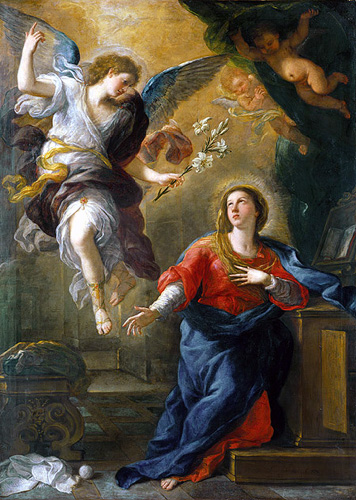
That this prayer was given such prominence in the daily Christian life in days past speaks a great deal to the significance of the mystery at its center: the mystery of the Incarnation of Jesus, the mystery of the Son of God becoming a man by being conceived, by the power of the Holy Spirit, in the womb of Mary.

The Incarnation of Jesus is one of the most beautiful and central mysteries of the Catholic faith.  While it is more often the Paschal Mystery (the Death and Resurrection of Jesus) that are emphasized, we must not forget that it was the Incarnation that made this greatest sacrifice possible.  But what is the Incarnation?

It's not uncommon that people will confused the Immaculate Conception with the Incarnation.  So let's make that distinction first.  The Immaculate Conception refers to the birth of Mary, the Mother of Jesus, and how she was redeemed by Christ ahead of time so that she was conceived without sin in order to be the pure Ark of the New Covenant.

The Incarnation, as was mentioned before, refers to the moment when Christ was conceived in Mary's virgin womb by the power of the Holy Spirit.  Of course, Jesus was also conceived without sin because He is God.  But it was fitting that God would redeem Mary before the Incarnation and from the moment of her conception, since fallen humanity begets fallen humanity due to the original sin of Adam and Eve which damaged our human nature.  But, furthermore, because Mary was free from original sin and its effects, she was able to make the most free choice to be the Mother of God because she was uninhibited by any characteristics of fallen human nature.  She was as free to say "yes" to God's plan as Adam and Eve were to say "no" to it before the fall.  God could have done this another way if He had chosen to, since He certainly has the power to do so.  But, as St. Thomas Aquinas would say, the way that God chose to become man was fitting.

Fra Angelico's Annunciation

But why does it matter?  It's a sweet, sentimental idea, right? Jesus becomes a little baby and we celebrate it every Christmas with a kind of nostalgic aura.  But to leave the Mystery of the Incarnation at that is to reduce its beauty and power to something much less than the Mystery is by its very nature.

Bishop Robert Barron, when he was still Father Robert Barron, made the connection or Jesus' Incarnation as related in the Gospel of Luke is meant to be like a military narrative of sorts.  This is why he begins his Gospel with details about how this event took place in such-and-such year, under the reign of Emperor Tiberius.  It seems like he's setting up a story of military conquest.  Yet, is the Gospel at all about Emperor Tiberius?  No.  The story transitions immediately into the narrative of Jesus Christ.  What Luke is doing is communicating that Jesus Christ is greater and more glorious than the Roman Emperor, though he has no earthly kingdom or armies, and He died upon a Cross like a common criminal.  Christ, who comes as a helpless infant, who is born in a stable, who is welcomed into the world by only Mary and Joseph and a few shepherds, is worth our attention far more than any leader that history would call "great."  


What is accomplished by this great mystery?  Our salvation begins here.  At the conception of Jesus in the womb of Mary, the hope we await has come incredibly close.  He is in Mary's womb for 9 months, and then He is born into the world on a night like any other, yet so unlike any other because God-become-man is being born!  This plan has been hidden from demons, and theologians speculate that the angels did not know it either until it had happened.  Such a message of hope: 

I bring you good news of great joy that will be for all people. 
Unto you is born this day in the city of David a Savior, Who is Christ the Lord.  

He is here! The salvation of the world has come! The uncrossable void between God and man that was created by the first sin has been bridged by the one who would leave the glory of heaven and be born as a helpless infant.  He becomes like us in all things by sin; He empties Himself to such a degree in order that we might be rescued from our sinful state.  Only the God-man can achieve this.  Why?  Because man could not obtain forgiveness for Himself; it had to be offered to Him by God.  But atonement for the sin was still necessary, and so God became a man in order to be the perfect sacrifice: He is human, so He can offer a sacrifice on behalf of all of humanity; He is God, so He can offer forgiveness to humanity through this sacrifice, and His sacrifice reaches through all of history because the infinite God offers it.  

What I would like to dwell on for a moment is the great humility of God that is revealed in the Incarnation.  

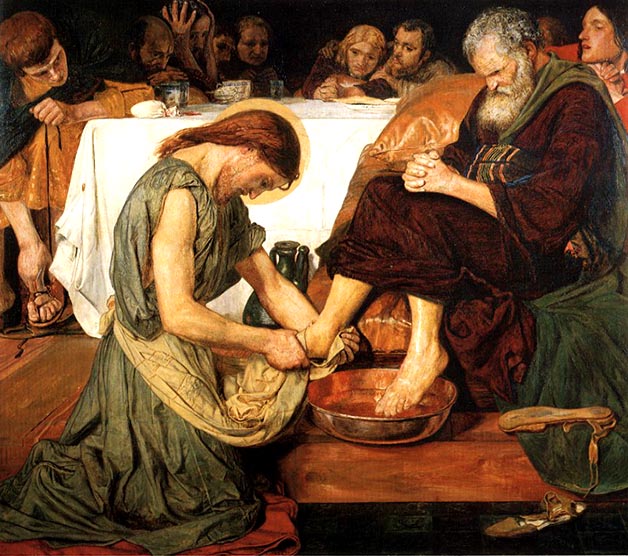
When we think of the humility of God, or even Google images of it, we think of Jesus washing the feet of the disciples, or His ultimate sacrifice on the Cross. 

It is not so often that we think of this moment of His Incarnation and entry into the world as a tremendous expression of the humility of God. 


Ecce humilitatem Dei. 
Behold the humility of God. 


It is this mystery that makes the redemption possible.  Had God not become incarnate, we would not be saved.  He became a tiny, helpless infant, totally reliant on St. Joseph and the Blessed Virgin Mary to care for Him.  He became vulnerable to such a degree as this.  Yet He was still seen as a threat, and so Herod sought His life.  But Joseph, guardian of the Holy Family, protected the Son of God and His Mother, as was the task given to him by God. How beautiful! (There will probably be a post on St. Joseph eventually. He is one of my favorite saints.)  

How amazing the experiences Mary and Joseph had with the Christ child must have been. 
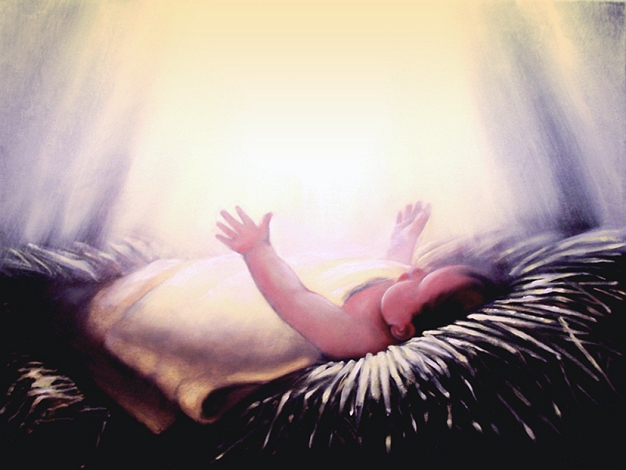
Think about how this little baby, God become man, would wrap His tiny fingers, which fashioned the stars, around the finger of Joseph or Mary. 
How the Word which spoke creation into being humbled Himself to the point of not knowing how to speak, and blessed the chatter of babes by becoming one. 
How the King of kings and Lord of lords was born in the most humble stable, and blessed the tiny dwelling of a few animals with His presence. 
How He was born in a mange in order to show that He would be the food for the world. 
How He was adored by simple shepherds to show that He came for all: from the lowest of men to the highest of kings.  

Here is the mystery that begins the Paschal Mystery, the source of our Redemption.  That we might be redeemed, this first took place, and the Son of God became like us in all things but sin, and was born of a woman.  His birth was not stately.  He came as one Who could be approached, approached without fear but with wonder nonetheless.  

O Holy night, the stars are brightly shining,
It is the night of our dear Savior's birth,
Long lay the world in sin and error pining,
Till He appeared and the soul felt its worth.
A thrill of old, the weary world rejoices,
For yonder breaks a new and glorious dawn.
Fall on your knees!
O hear the angel voices!
O night, divine! 
O night, when Christ was born. 

Caravaggio's Adoration of the Shepherds
There shall come forth a shoot from the stump of Jesse, and a branch shall grow out of his roots. 
~Isaiah 11:1~
The wolf shall dwell with the lamb, and the leopard shall lie down with the kid, and the calf and the lion shall eat straw like the ox. The sucking child shall play over the hole of the asp, and the weaned child shall put his hand on the adder's den. 
~Isaiah 11:6-8~
For to us a child is born, to us a son is given. 
~Isaiah 9:6~
Who has believed what we have heard? And to whom has the arm of the LORD been revealed? For he grew up before him like a young plant, and like a root out of dry ground; he had no form or comeliness that we should look at him, and no beauty that we should desire him. 
~Isaiah 53:1-2~
And the government shall be upon his shoulder, and his name shall be called "Wonderful Counselor, Might God, Everlasting Father, Prince of Peace." Of the increase of his government and of peace there will be no end, upon the throne of David, and over his kingdom, to establish it, and to uphold it with justice and with righteousness from this time forth and for evermore. The zeal of the Lord of hosts will do this. 
~Isaiah 9:6-7~
"And this will be a sign for you: you will find a babe wrapped in swaddling cloths and lying in a manger."
~Luke 2:12~

Once again, I find myself in awe of this great mystery. May I not live my life the same way as before in light of this knowledge of the mystery of the Incarnation. 

Until we meet again, 
Pace e bene!
the Itinerant Catechist


Tuesday, July 5, 2016

Christ in Contemporary Culture: Doctor Who

There will be a number of posts like this one, I hope, since I have a great affinity for great stories, whether they are written works, films, tv shows, or otherwise. One of my more recent "fandoms" has been Doctor Who. Since last summer, I have watched from the first series (Eccleston) to the seventh series (Smith).  It has been a great adventure! I've laughed, cried, and pondered through episode after episode and I'm anxious to go back and re-watch the seasons and episodes I have enjoyed most (maybe when grad school studies have calmed down...).

I could probably say a lot about my favorite characters, favorite companions (Amy and Rory, but very closely followed by Donna), favorite Doctor (still not 100% decided on that yet, but...I lean towards 11).  It's been wonderful to learn the lingo of the Whovians, and to fall in love with the Doctor and friends. But the reason I'm talking about Doctor Who today is to talk about some of the Catholic values and themes I have found as I've been watching the show.

Above all, I've noticed the theme of value for life. The Doctor is almost never okay with any behavior or practice that does not respect the dignity of life. There have been a number of episodes where there is some sort of experimentation, masked torture, mind control, artificial reproduction technology/cloning, or otherwise relatable issue going on.  And every time, the Doctor shows up on the scene and says: "This is not okay."  The manipulation of life to the benefit of the few is disgusting to him.  Furthermore, whenever said situation turns sour and now the life that the "clever ones" have created begins turning on them in a way they did not expect, of course the "clever ones" think the solution is: let's kill it. But the Doctor never believes this is the first and only solution. The episode that most comes to mind for me in this case is Rebel Flesh (Series 6, episode 5).  If you've not seen it, you might want to skip ahead until you see the next picture of David Tennant.

Premise: an old monastery, functioning as a laboratory, has been "creating" people.  Except they don't really think of them as people. They think of them as resources. They do the dangerous work so that the people they're patterned off of can stay in safety. Inevitably, an accident occurs.  And suddenly, those "resources" aren't so content to be just that.  The separation that once was considered to exist between the clones and the persons they're clones of is suddenly gone.  The clones believe the memories they have are suddenly their own.  But the "originals" are not prepared to handle this. They're not very happy with the idea of other versions of themselves walking around, into their lives and into their homes as if they belonged there. But to the clones, they aren't different people from the "originals." Those homes and memories and families they really believe are their own.  Towards the end of the episode, one of the clones realizes that he is not the father of the "original's" son; but he takes up the role when the true father is killed in an accident.

As a Catholic viewer watching this show, I kept thinking about the Church's teaching about these kinds of technologies. I couldn't help thinking about how the problem presented in this episode communicates the serious issues that cloning presents.  It does not respect life, either of the person being cloned or of the cloned person.  What else is the issue?  Exactly what happens in the episode. Once this clone has a life of its own, what happens? They might not be exactly what the designers had planned them to be. So what do they want to do with them then? Well, they made these lives, so they think that gives them the authority to take life away from them. The Doctor says: "No way." And he'd be right.  While these lives were conceived in a way that is outside of God's plan, now that they're here they are living persons and they have that same dignity that needs to be respected.  You can't just kill them and think that it's not actually a person that is being killed.  The technology being used to artificially create life is something that should have never happened. But it would be a greater evil to destroy those lives now that they have been brought to life.

It's a complicated issue, right?  That's why the Church teaches what it does.  Man has no authority to make calls over who lives and who doesn't.  To give life and to take it away belongs to God alone who is the Author of all life.  When man thinks he does have this kind of authority, not only to rule over life and death, but also to create life in a way that is outside of God's plan, so suddenly the attitude becomes: "we don't need God," and problems inevitably arise.


Another great aspect of Doctor Who (and a heartbreaking one at that) is the Doctor's relationship with his companions.  He knows that their lives will never be the same after traveling with him.  And after Rose, Martha, and Donna (especially Donna) he becomes especially afraid of taking anyone with him because he knows what can happen.  He doesn't take it lightly with an attitude of: "It comes with the territory." He could. But he knows that he bears some responsibility for what happened since he did bring them into the situations that they experience together and these experiences have some serious ramifications. But, throughout these adventures, and after some time spent on his own, the Doctor comes to realize that he can't do it on his own.  It's a lesson in vulnerability.  In the words of C.S. Lewis: "To love at all is to be vulnerable."  I think this is evident in Doctor Who. And I don't mean love in the narrow sense of romantic love. Just look at the Doctor and Donna, one of my favorite Doctor-companion duos.  What is truly refreshing about this series is that there is no romantic interest between Donna and the Doctor. What is there is a good friendship, one that the Doctor truly values. So much so that, I'd say, it leads up to one of the most heartbreaking separations between Doctor and companion. 


And don't even get me started on all of the great quotes in the show that communicate a value for life. 

Too late. 


SPOILER ALERT with this next one. Avert your eyes if you don't know what happens at the end of the fourth series. 

END OF SPOILERS.


I love the show, obviously, and hope to continue watching it. Haven't gotten to Capaldi yet, but hopefully I will soon.  Also, this was kind of a slapdash post, so...there may be more in the future about Doctor Who. In the meantime, I hope finish reading this post and decide it's time to make a cup of tea and cozy up with an episode of the fabulous Doctor Who.  

Until we meet again, 
the Itinerant Catechist 
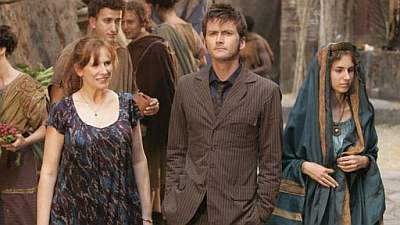
"Geronimo!" 


Wednesday, June 22, 2016

The Light-Bearer's Blunder

God said, "Let there be light," and there was. 

As Catholics we believe in the existence of angels, those who have chosen to obey God and those who have turned away from Him (which we call fallen angles, or demons).  It has always puzzled me, though, that the creation of the angels is not clearly identifiable.  However, in my Masters studies, a professor proposed that the creation of the light on the first day, which is then separated from the dark, is an allusion to the creation of the angels.  This would make sense on some level, since God makes the sun, moon, and stars later in the narrative, which we know as our sources of light in the universe.

Initially, I wasn't sure what I thought about this.  But when I proceeded to do a search for icons depicting the creation of the world, I noticed, as you will see in the icon posted above (and a close-up below), that the light is actually depicted with faces and wings, much like depictions of the angles in classic artwork (particularly representations of the Serpahim, which are described also in the book of Isaiah). 


The interpretation that follows from this position is that the separation of the light from the dark would indicate the test of the angels and the fall of Lucifer (who becomes Satan) and his followers (the demons).  

It's important to understand something about the nature of the angels before we go any further.  Angels have intellect and will, much like humans do. However, angels are pure spirit.  Therefore, their intellect is superior to that of humans, and the will and intellect of an angel are in perfect harmony.  Their learning is not hindered by the flesh the way human learning is.  The Catechism of the Catholic Church says: 

As purely spiritual creatures angels have intelligence and will: they are personal and immortal creatures, surpassing in perfection all visible creatures, as the splendor of their glory bears witness (330).  

Why does this matter? Because we have to understand that the fall of the angels (now demons) and their eternal state that results is not an injustice.  When angels choose, they choose with their whole being.  There is no hindrance in the connection between their intellect and their will.  Therefore, the decision that the demons made to not serve the Lord was one in which they fully knew what they were choosing.  They do not look back on that moment and think: "Shoot, I really messed up there."  They committed to their decision fully because that is in their nature as pure spirits ("pure" being used in the sense that this is fully, completely, and only what they are).  

Tolkien communicates this well in the creation myth he wrote for Middle Earth.  Tolkien beautifully described the creation story like a celestial symphony.  Iluvatar (who is an image of God) created the Ainur, also called the Holy Ones, who "were with him before aught else was made" (which alludes to the angels).     

And he spoke to them, propounding to them themes of music; and they sang before him, and he was glad...And it came to pass that Ilúvatar called together all the Ainur and declared to them a mighty theme, unfolding to them things greater and more wonderful than he had yet revealed; and the glory of its beginning and the splendor of its end amazed the Ainur, so that they bowed before Ilúvatar and were silent. 
Then Ilúvatar said to them: ‘Of the theme that I have declared to you, I will now that ye make in harmony together a Great Music. And since I have kindled you with the Flame Imperishable, ye shall show forth your powers in adorning this theme, each with his own thoughts and devices, if he will. But I will sit and hearken, and be glad that through you great beauty has been wakened into song.  

Ainulindale V by Anduin1000 on DeviantArt
The Ainur make beautiful, harmonized music before their Creator.  But one of the Ainur, Melkor, decides that he doesn't like Iluvatar's melody.  

But as the theme progressed, it came into the heart of Melkor to interweave matters of his own imagining that were not in accord with the theme of Ilúvatar; for he sought therein to increase the power and glory of the part assigned to himself. To Melkor among the Ainur had been given the greatest gifts of power and knowledge, and he had a share in all the gifts of his brethren. ...Some of these thoughts he now wove into his music, and straight-way discord arose about him, and many that sang nigh him grew despondent, and their thought was disturbed and their music faltered; but some began to attune their music to his rather than to the thought which they had at first. Then the discord of Melkor spread ever wider, and the melodies which had been heard before foundered in a sea of turbulent sound. But Ilúvatar sat and hearkened until it seemed that about his throne there was a raging storm, as of dark waters that made war one upon another in an endless wrath that would not be assuaged.  
Then Ilúvatar arose, and the Ainur perceived that he smiled; and he lifted up his left hand, and a new theme began amid the storm, like and yet unlike to the former theme, and it gathered power and had new beauty. But the discord of Melkor rose in uproar and contended with it, and again there was a war of sound more violent than before, until many of the Ainur were dismayed and sang no longer, and Melkor had the mastery. Then again Ilúvatar arose, and the Ainur perceived that his countenance was stern; and he lifted up his right hand, and behold! a third theme grew amid the confusion, and it was unlike the others. For it seemed at first soft and sweet, a mere rippling of gentle sounds in delicate melodies; but it could not be quenched, and it took to itself power and profundity. And it seemed at last that there were two musics progressing at one time before the seat of Ilúvatar, and they were utterly at variance. The one was deep and wide and beautiful, but slow and blended with an immeasurable sorrow, from which its beauty chiefly came. The other had now achieved a unity of its own; but it was loud, and vain, and endlessly repeated; and it had little harmony, but rather a clamorous unison as of many trumpets braying upon a few notes. And it essayed to drown the other music by the violence of its voice, but it seemed that its most triumphant notes were taken by the other and woven into its own solemn pattern.


Sound familiar?  If anyone knows the traditional story of the fall of the angels, it's not difficult to see who Tolkien is trying to represent in the character of Melkor.  Lucifer, the Light Bearer, once was one of the highest angels.  In Tolkien's story, Melkor decides he wants glory apart from Iluvatar.  He creates discord among the other Ainur.  Yet Iluvatar makes it clear that he is the one in control. He is so in control that even the triumphant notes of Melkor are taken up in Iluvatar's melody and woven into the pattern.  What this means is not that the evil Melkor stirs up is turned into a good, but that a good is drawn out of it.  Sounds like Divine Providence if you ask me.  

Then the Ainur were afraid, and they did not yet comprehend the words that were said to them; and Melkor was filled with shame, of which came secret anger. But Ilúvatar arose in splendour, and he went forth from the fair regions that he had made for the Ainur; and the Ainur followed him. 

And so the question arises.  What was the angels' test?  

The test put to the angels is traditionally expressed in terms of service.  The response of Lucifer to this request or revelation from God is: "I will not serve."  To which Michael responds: "Who is like unto God?" (In fact, that is what his name means in Hebrew. Micha + el.) 

The reason that I chose to write about this (rather lengthy) subject is academic in origin.  My professor, in speaking about God's transcendence, and the whole mystery of creation in light of God's transcendence, proposed an analogy that shed light on the choice of the demons not to serve (and, more importantly, the choice of the angels to serve).  

I briefly touched on the subject of transcendence in the last post (Dirty Hands).  But it's important here, as well. (In truth, I think it sheds light on all the truths of the Faith.) For the record, I take no credit for the following analogy. I was privileged to receive it from Prof. John Cavadini and it helped me to reach a place of wonder. I hope it will do the same for you. 

The angels, because they were created first, were witnesses to the work of creation (that is, the creation that happened after they were created).  Imagine this, if you will.  They are watching God, whom they know to be totally fulfilled in Himself because He is an eternal exchange of love (as He is a Communion of Persons, the Trinity).  They know that He has no need to create.  And yet, here He is, making a beautiful universe.  My professor compared it to some sort of whimsical action on God's part, where God has everything He could possibly need, and yet He goes out and creates the most elegant and beautiful seaside carousel.  (Told you it was going to be whimsical.)  In this act, God is not creating something to make Himself happier or satisfy Himself.  He has no need to do that.  His creation of the universe transcends His wisdom and love by going beyond what we would expect or think to be enough.  

This is what Lucifer can't understand.  He looks at this "fanciful" work of God and he shakes his head and says: "That's stupid. Why would you ever do that?" Because he can't comprehend why God would stoop to this act of creation that He has no need for, Lucifer determines that he can't serve a God like that.  He can't serve a God Who is great beyond imagination or comprehension, but Who will also stoop so low as to make this universe and these puny human beings.  And He doesn't just make them, but He sustains them rather then leave them to their own devices! Lucifer can't understand it. So his response is, "I will not serve."  And others of the same mindset follow. 

On the other side of this, we find the angels.  Michael calls out: "Who is like unto God?" Because of Cavadini's analogy, I now come to a place where I see this as an expression of profound trust in God's transcendence. Michael and the rest of the angels who choose to serve God see the same thing that Lucifer and the fallen angels see; but rather than see that and think God is foolish, they trust that God's wisdom transcends wisdom and they choose to trust in God because there is no other like unto Him.  
St. Michael, defend us!
Like Melkor, Lucifer became proud.  He wanted a glory apart from God's because God was taking actions that Lucifer considered "beneath God."  And so, Lucifer, once the Light-Bearer, becomes Satan, the father of lies.  Satan and the demons are cast down from the heavens.  It's comparable to what the prophet Isaiah says of the king of Babylon in Isaiah 14: 12-15. 


“How you are fallen from heaven,
O Day Star, son of Dawn!
How you are cut down to the ground,
you who laid the nations low!
You said in your heart,
‘I will ascend to heaven;
above the stars of God
I will set my throne on high;
I will sit on the mount of assembly
in the far north;
I will ascend above the heights of the clouds,
I will make myself like the Most High.’
But you are brought down to Sheol,
to the depths of the Pit. 


And, like Melkor, Satan harbors anger in his heart. (Though of course, it is no secret from God.) But he can't touch God, so how does he "get back" at God? He harms the creation.  To return to Cavadini's analogy, he throws a wrench into the works of the carousel and laughs as it all falls apart.  This is the fall, following the original sin of man and woman.  But God is not shaken or befuddled by this.  Tolkien paints Iluvatar in The Silmarillion as smiling, then stern.  He is not beaten.  He has a plan. With all His foreknowledge, God knew what Satan would do, and He knows what He will do in response.

...and he lifted up his right hand, and behold! a third theme grew amid the confusion, and it was unlike the others. For it seemed at first soft and sweet, a mere rippling of gentle sounds in delicate melodies; but it could not be quenched, and it took to itself power and profundity. And it seemed at last that there were two musics progressing at one time before the seat of Ilúvatar, and they were utterly at variance.

Tolkien is alluding to Catholic theology here.  Yes, Satan has thrown a wrench in the works.  But God's plan goes on.  Not only that, but no matter what evil Satan and the demons bring into the mix, they are never more powerful than God.  God can always bring a greater good out of the evils that arise.  That's not to say that "magically" evil becomes good; no, that is impossible. But God, in His infinite goodness and power, can bring something good out of the situation.  For instance, a disaster or tragedy, while it brings death and suffering, somehow brings people together to strengthen and help one another.

I think this is what Tolkien has in mind when he says of the two themes of music:

The one was deep and wide and beautiful, but slow and blended with an immeasurable sorrow, from which its beauty chiefly came.

 This is the divine theme of God's Providence. 

 The other had now achieved a unity of its own; but it was loud, and vain, and endlessly repeated; and it had little harmony, but rather a clamorous unison as of many trumpets braying upon a few notes. And it essayed to drown the other music by the violence of its voice...


And this is the theme of the demons.

...but it seemed that its most triumphant notes were taken by the other and woven into its own solemn pattern. 

God brings a greater good. 

The Light-Bearer's Blunder, then, was that he refused to be "taken in" by God's transcendence.  He thought it foolish, frivolous, needless.  He thought it shameful for God to stoop so low as to make something He didn't even need.  But he fails to understand the transcendent love of God.  He cannot comprehend it.  No creature fully can.  But he also fails to trust it.  The angels don't.  And so the light is separated from the dark. 

Now, I will put in a small disclaimer here.  I am a student of theology, not a theologian.  I have no degree in Theology of Angels. I have done my best to present the angels as the Catechism and the Church have declared them to be, but some of the points I made may be open for speculation.  What I'm trying to say is: if there is any misunderstanding on my part of the teachings of the Church, I did not intend to misrepresent these teachings and would be grateful for correction from someone who has a more thorough knowledge of the subject than I do.  

I have found this beautiful reflection eye-opening.  That is why I have tried to share it with you. I can only hope and pray that I have helped you to glimpse a little more of the depths of the beauty that is the Christian Faith.

Until we meet again, I remain,
the Itinerant Catechist


Saturday, June 18, 2016

Dirty Hands


The word that came to Jeremiah from the Lord: "Arise and go down to the potter's house, and there I will let you hear my words." So I went down to the potter's house, and there he was working at his wheel. And the vessel he was making of clay was spoiled in the potter's hand, and he reworked it into another vessel, as it seemed good to the potter to do. Then the word of the LORD came to me: "O house of Israel, can I not do with you as this potter has done? says the LORD. Behold, like the clay in the potter's hand, so are you in my hand, O house of Israel." 
~Jeremiah 18:1-6~ 

While my experience with a potter's wheel is almost non-existent, I have had many opportunities to work with clay in the art of ceramics.  This is thanks to my mother's artistic pursuits and knowledge, which she saw fit to hand on to all of her children. 

A bit of context for why I chose to write about this: We are in the midst of our orientation in Echo.  Things are going very well. In these last few days, though, I have noticed themes that keep returning for me personally.  It was the case, especially on the first day here, where it seemed like the Lord would place on my mind or my heart something that I needed to think about and pray about.  Soon after that moment of acknowledgment, something related to that inspiration would be brought up in the session/discussions.  I'm so thankful to God for this because it is helping me to realize these areas are areas that I need growth and that I want to grow in.  Some of these themes have been: vulnerability, gratitude, and formation/conversion requiring a desire to be changed.  

On our third day of orientation, we had an opportunity to dive into the passage from Jeremiah in a very tactile fashion.  We listened to the passage as we sat in a ceramic studio, and were encouraged to engage our senses as we explored the clay.  Now, clay is a familiar medium for me, so the experience was not exactly new.  But the reflections that were brought forward by many of my colleagues were very inspiring and provoked me to think about some conclusions we can draw from this passage but that I think we tend to overlook, whether that's because they make us uncomfortable or we just don't understand the potter's work and it's connection with God and His work.  

God tells Jeremiah that it is God who is like the potter.  The people of Israel (who represent us) are the clay.  And God helps Jeremiah to understand that just as the potter sometimes collapses his work and restarts/reforms the vessel, so God can do with us.  

What does that mean? 

Picture the potter at work.  Maybe you've seen a ceramicist work, maybe you haven't. It involves a lot of "hand work."  When the potter first takes the clay, he/she has to feel the clay to determine its pliancy.  Usually the clay is fairly pliable when it's taken from the larger brick/mound, but it does take some force to pull it away from the rest of the clay.  As the potter works with the clay, he employs various techniques to form the clay and make it more pliable/workable.  If the clay starts to become dry, stiff, or cracked, he adds water to help the clay bind to itself more.  If the clay is too wet, the potter has to work some of the moisture out again.  

Inevitably, the potter's hands get dirty.  If it's your first time working with clay, or if you just don't like things sticking to your hands, then this can feel strange and uncomfortable.  But for someone who does it every day it becomes a familiar sensation to them.  To really have fun with the clay and make progress in the act of making something, you have to become okay with the mess that gets all over your hands and work with that to create something beautiful.  


What struck me about this analogy is that the same that is true of the potter is true of our God.  God is a potter who is not afraid to get His hands dirty with us in order to transform us into something beautiful.  Think about that.  I think it has become normal for us to "hide our mess" in today's culture.  We don't want people to see our weaknesses or struggles because we're afraid that they'll be turned off by them and we'll be left alone.  We can project this image onto God.  God wants to work with our weaknesses and form us through our struggles; but sometimes we're so busy hiding it or pretending that it isn't there that we deny Him that privilege of transformation.  When there is this resistance in us, it becomes more difficult for us to be formed into the people we are meant to be.  Similarly, sometimes the only way to get your clay smooth and to have a good surface for working is to slap it against the table or roll it with a rolling pin.  I think this is also significant.  Sometimes in life, we find ourselves up against a wall with difficulties we never expected. But if we cling to the Lord in those moments and seek His will, we can find ourselves coming out of those struggles stronger and better people than we were before.  This isn't just a nice idea.  It's a part of our faith.  Now I'm not saying that "Everything happens for a reason" should be your instant reaction to any difficulties that come your way.  Sometimes it's just not possible for us to feel that way.  But there's a difference between adopting an attitude of nonchalance and living a life of faith.  Nonchalance says: "I guess there's some good that will come of this."  Faith believes: "This is a bad situation. And what's happening to me doesn't feel good, and I didn't do anything to cause this. But I know my God is powerful enough to bring a good out of this, and I believe that He will."  

We can easily see how this is amazing for us, that God is not afraid to work with us, in our good times and our bad times, to help us to become what He made us to be.  He is not afraid to get His hands dirty.  But it's easy to miss how significant this is for God as well.  How so? 

One of the ways the Catholic Church likes to describe God is "transcendent." This means that He surpasses all we know and understand to be beautiful, good, true, mighty, the list goes on. Another great mystery of the Catholic Faith (the central mystery, in fact) is that God is a Trinity, or a Communion of Persons.  Now, the Trinity, as a mystery, is something that we could talk about all day because it is so profound, or something that we could have trouble speaking about because it is so deep and so beyond our imagination.  But one of the best ways that I have ever heard of explaining the doctrine of the Trinity is in a children's catechism called St. Patrick's Summer by Marigold Hunt.  
In this catechism, or adventure catechism as Hunt has called it, two children and St. Patrick are having a discussion.  

Patrick says: “You and I are three persons too, aren’t we?  But we each have a human nature of our own: three persons with one human nature each, and you know that your nature is what you are. Now tell me, is what you are the same thing as who you are” (20)?  

An example is then presented that if you were to bump into another human in the dark you might say: “What was that?” And the answer would be: a human. But once you knew that, you would ask further: “Who is that?” They are not the same thing. 

“The mystery isn’t how three can be one or how one can be three at all: you can’t even get near the mystery until you understand that much. The mystery is how it can be that if you asked God, ‘What are You?’ the answer would be simply, ‘God,’ but if you asked, ‘Who are You?’ the answer would be threefold” (22). 

I bring this up because it's important for us to realize that God does not need to make us.  God is a Community of Persons, an Eternal Exchange of Love between the Father, Son, and Holy Spirit.  God is Love. But His Love is also fulfilled in His being.  But then the mystery of why God creates us is even more beautiful.  He does not have any need to create us, but He does so because His love goes beyond fulfillment. It is transcendent.  God's creation of us could almost be seen as frivolous, even whimsical, because it wasn't necessary.  Like the Cross, it is foolishness to some, yet it is the power of God for us who believe.  It is so amazingly and transcendently beautiful!    

Following from this truth, how amazing is it that, even after man rebels against God through sin and falls from grace, God still loves us; still stoops down and saves us; still works with us in our mess and helps us rise out of it?  We know this because God has become man and has saved us.  He did not have to do this.  He could have started over.  But throughout salvation history, He continues to stoop down to His people and to sanctify them.  This is accomplished ultimately in Jesus Christ's life, death, and Resurrection.  "Oh happy fault, which gained for us so great a Redeemer!" (from The Easter Vigil Liturgy) 


I will, most likely, carry on this theme in further posts, since it is too great a mystery to speak about in just a few paragraphs (and the potter and clay analogy has already been long). Until we meet again, may the Lord bless you. 

Pax et bonum,
the Itinerant Catechist