Tuesday, March 31, 2020

Questions, Quests, and Quarantines

aka "Frozen II and the Spiritual Life"

When Disney+ announced that "Frozen II" would be released early to the public due to the COVID-19 quarantines of 2020, I thought: "Hey, that's great for families." Second, I thought: "Hey, this means I can watch it!" 

I did not go to see the film in theaters since I was not convinced by trailers that it would be as stunning as the original. ("Frozen" has a special place in my heart since I (a) my sister and I both really liked it and connected with the characters, and (2) I saw it right before going to study abroad in Austria for a semester, so the movie itself and the music always take me back. Plus, that opening sequence - how could you not love that stunning montage?) 


But I have to say, I was very surprised at how much I enjoyed Frozen II! Naturally, this is because I saw a lot of deeper themes within the movie that have roots in Christian spirituality, which is (as you've probably guessed) what this post will be about. 

I started noticing these themes... 

in Olaf and Anna's first conversation in the movie. It starts off very comical, as Olaf comments that "change mocks us with her beauty" and then casually asks Anna (since she's "older and thus all-knowing"): "Do you ever worry about the notion that nothing is permanent?" 

As the first major musical number of the movie ("Some Things Never Change") starts, it becomes clearer what we'll see each of the characters representing and wrestling with in the rest of the movie. 

Olaf represents the childlike: he (we might say naively) trusts that someday he will understand, and, until then, he seems content to roll with whatever comes his way. 

Anna's focus is on not being alone, on staying close to the ones she loves both to protect them and because she feels safe and at home with them. She "relies on certain certainties," all of which are based on what the true, good, and beautiful. But we will also Anna's "certain certainties" challenged as the film goes on, which the song pre-empts as some of Anna's examples of things that stand firm actually are failing or falling around them. 

Meanwhile, Kristoff is wrestling with self-doubt as he faces the possibility of a major change in his relationship with Anna. He knows what he wants to do, but he wants to do it right and the pressure of getting it right is real. (Sven, as usual, is there for emotional support.) 

What about the Queen of Arendelle? Well, Elsa also expresses in this song a desire for things to stay the same because everything seems so good. But at the same time, she is experiencing a mysterious call that won't let her keep still. 

As the story begins, Elsa confides to Anna: "I just don't want to mess things up." But Anna reassures her saying: "When will you see yourself the way I see you?" By all accounts, it seems Elsa is doing well as Arendelle's new queen. In the previous song, we saw the people gathering in the square to celebrate a kind of Thanksgiving/harvest feast, the people all appear happy and satisfied, Elsa even uses her powers to create "ice toys" for the children. All seems to be well! 

But for Elsa, the mysterious call won't let her be, even after Anna reassures her. Cue the musical number!

Into the Unknown

Not much unlike "Let it Go" in Frozen, this song from Elsa's perspective is probably the most highlighted song of the movie. I admit, when I heard it, I was struck by the spiritual themes within. 

Elsa wakes to hear the call echoing through the castle, and she wrestles within herself. Part of her does not want to listen to the voice, resisting change. But she also can't help herself: she wants to know where the voice is coming from and where it's calling her to go. 


I can hear you but I won't
Some look for trouble while others don't
There's a thousand reasons I should go about my day
And ignore your whispers which I wish would go away.

You're not a voice
You're just a ringing in my ear
And if I heard you, which I don't
I'm spoken for I fear

Everyone I've ever loved is here within these walls
I'm sorry, secret siren, but I'm blocking out your calls
I've had my adventure, I don't need something new
I'm afraid of what I'm risking if I follow you

Into the unknown...

Almost instantly, I felt a personal connection with Elsa's words. As I've sought God's will and my vocation over the years, I've been Elsa in this moment. There's a constant back-and-forth within the self: a desire for things to stay the same (because after all, right here is, more or less, comfortable!), but at the same time a curiosity and draw to something more that God may be calling me to. I think this challenge is even more real when I know I've recently followed God's will to where I am now, but that question of "vocation" as it pertains to married, religious, or single life still hangs in the air. I love where I am right now; but maybe God has something more in mind.... Within the desire to know God's will, there's a lot of questioning that goes on, even in the midst of a lot of prayer: "Is this God's voice? Or is it my imagination? Or maybe it's a distraction from here and now, where my focus should be?" 

What do you want? 'Cause you've been keeping me awake
Are you here to distract me so I make a big mistake?
Or are you someone out there who's a little bit like me?
Who knows deep down I'm not where I'm meant to be?


Every day's a little harder as I feel my power grow
Don't you know there's part of me that longs to go…

Into the unknown?

...
Are you out there?
Do you know me?
Can you feel me?
Can you show me?
...
Where are you going?
Don't leave me alone
How do I follow you
Into the unknown?

At this point, I can't help but be reminded of Thomas Merton's prayer, where he says (which hopefully helps you breathe, if the "vocational confusion anxiety" has started to set in; don't worry, I get it): 

O Lord God,
I have no idea where I am going,
I do not see the road ahead of me,
I cannot know for certain where it will end.
Nor do I really know myself,
And that fact that I think
I am following Your will
Does not mean that I am actually doing so.
But I believe
That the desire to please You
Does in fact please You....

I still marvel when I listen to "Into the Unknown" at the depths of the searching soul that are expressed here. This is one of my favorite things about being Catholic - finding the One Who is Beauty in things that are beautiful, even if they're not "religious" in intent. 

Then...

When Elsa takes the first step in answering this call, things get a little chaotic. But as she opens up to people she trusts, she confesses her belief that whatever or whoever is calling her is good. She somehow knows this, in spite of rather dooming stories she and Anna have heard about the past. 

Our old friends the trolls make their first appearance here, and Pabbie informs the sisters that the fate of Arendelle rests on a wrong being righted. It is also in this moment we first encounter the theme: "When one can see no future all one can do is the next right thing." 

Would you believe we are only 20 minutes into this movie? Well it's true! There's so much here! But I'm going to pause here for now so we can all revel in the richness that we've found so far. 

Until next time, keep pursuing and encountering beauty.

The Itinerant Catechist

Sunday, March 22, 2020

Back at It!

Hello, everyone!

It has been a long time since I last wrote here, and a lot has happened since then! Let me try to bring you all up to speed with some of my life events of the last...year and a half? Something like that. Let's just say the "Itinerant Catechist" has been doing a lot of "itinerating" since then. (I think that's a word.)

From Florida to the Midwest

At the end of May 2018, I made the long drive from Jacksonville to Ohio after finishing my 2 years of service at a parish in Florida.

In June of 2018, I wrote and presented for my Masters in Theology through the University of Notre Dame's Echo program. Throughout that process, I continued to be amazed at the beauty of the faith as I was privileged to study it more and more deeply. It may sound weird, and it definitely sounds nerdy, but I enjoyed writing my capstone.

It was also a tremendous gift to see my classmates present on their capstones as well, to see their unique gifts and incredible wisdom shine through their being. To celebrate our graduation Mass, and singing out "O God Beyond All Praising" with tears of joy in my eyes...it's something I will always cherish.

From the Midwest to the Smoky Mountains

After finishing my capstone and a couple of weeks at home, I (and my amazing parents) moved myself and my belongings to Knoxville, TN, to begin a position as the Director of Youth and Young Adult ministry at a parish there. 

During my time in Knoxville, I encountered so many incredible people and made several new friends whose hearts and souls inspired me to grow in holiness and hospitality each day. I also had the opportunity to be a part of an amazing movement called the "St. Meinrad Young Adult Initiative". 


This initiative was another great blessing in my life, as it opened my mind and heart to new ideas and strategies for encountering the young Church. 

Like any (or at least the majority of) first year in youth and young adult ministry, there were a lot of challenges, mostly just in trying to set the ground work and get things going. I had my past formation in youth ministry at Franciscan University which had prepared me for this first-year struggle, and so I was not surprised by this hurdle. But circumstances beyond my control shifted pretty dramatically during Holy Week of 2019 - which became a real opportunity to unite myself to Christ's sufferings. Nevertheless, I was determined to keep trying...until it more or less became clear that I might not be given the opportunity to do so. *

But, to quote Scripture: "We know that all things work together for good for those who love God, who are called according to his purpose" (Romans 8:28). This saying did indeed prove trustworthy, for in the middle of all the "What am I going to do?" and "Why did this happen?" there came a clarity - this was an opportunity, a door that I could choose to walk through. 


Through prayer and a number of heart-to-heart conversations with friends, family, and mentors alike, I found myself recognizing something of my own situation in the Gospel story of the Annunciation to Mary. Interestingly, earlier in the year when the feast of the Annunciation came around, I found myself mysteriously drawn into the feast more than I had ever felt before.... The connection would continue to grow as I had the opportunity to take a group to Camp Covecrest for a week, and the theme? "Fiat." 


During this week, again the moments of grace kept cropping up - conversations with complete strangers, the homilies at Mass, the talks themselves...it all kept re-echoing the message of surrender, trust, and a resounding "yes" to God's invitation, even though it meant leaving behind my own ideas of how my life was going to look. 

*As you might have guessed, there's a lot more to this story; but my goal in writing this post is to give glory to God for His goodness, not get into the details of the sufferings and challenges of the situation. 

The Lord Provides - back to the Midwest

So, through the gracious gift of God, I received the offer to become a middle school Religion teacher at a school in Indiana. Again, there are a lot of details where Divine Providence totally blew me away in this process and how good the Lord is. But that's a story better told face-to-face, so if you'd like to know more, we'll just have to sit down over a cup of coffee someday. 

I am now 7 months into teaching, and surprise, we now have to relearn how to teach because our students can't come to school due to COVID-19. But hey! The Lord provides again, and so far the transition has been surprisingly smooth. 

Why am I back in the blogosphere? 

I've had some thoughts on the goings-on of the last couple of weeks, the Mass readings to accompany, and just the rich history of our Catholic faith that I'd like to delve into with willing readers. These "smatterings" will bring in Deuteronomy, St. Joseph, Frozen II, Vienna's plague pillar, and who knows what other connections the Holy Spirit may make. But the above is just a little way of my saying "hello, again!" after a long hiatus, and hopefully an opportunity to invite you all back to reading some reflections on our Catholic faith again. 

Stay home, and stay healthy, friends. Keep making those Acts of Spiritual Communion - and may we come to yearn for our Lord in the Blessed Sacrament like a bride longing for her husband. 

Happy Laetare Sunday! 
-The Itinerant Catechist

Thursday, February 15, 2018

Does God Love Her More than Me?

One of the aspects of being the theology nerd of the family (as a student of the field for almost six years now) is that I am the family member who gets calls and texts about theological matters.  Bible stories, Church teachings, morality, you name it.  It's a little amusing to me, as we all know our faith well (having been a homeschooling Catholic family).  But it's also a great honor.

One of those messages has got me thinking hard about the importance of knowing our faith in the context of a lived relationship with God.

It was about an encounter that one of my siblings had this summer in a small group discussion, and this sibling told me that she has been thinking about it for a while and has been wrestling with it.

First of all, I want to affirm that the wrestling is good.  To wrestle with a matter of our faith is a commendable thing insofar as it is a desire to know the truth and a firm conviction to believe.  This wrestling says: "I want to know the answer."  It isn't doubt, it isn't dissent; it's just what it is - wrestling.  Seeking.  Searching.

My sibling had this encounter with a person who believed that God loves good people more than He loves sinners.  This sibling of mine then told me that she and the others in her small group spent the rest of the time trying to explain "...that God loves each of us with perfect love.  He loves each person and longs for a relationship with them, whether they're sinful or not," and that He especially wants to call sinners to relationship with Him.  They also reminded this person of the story of the Prodigal Son.  (Nice work, young church! You're definitely on the right track! #proudofyou) While they were not able to finish the discussion, the person's thoughts on the matter didn't change, and this person also expressed their belief "...that a perfect parent should love the good child more than the bad child."  This person also brought up Mary - does God love Mary more than the rest of humanity?  The person fielding questions at that time answered "yes."

[I should preface this by saying that some theologians have a different stance on this than I do.  The content of this post is my response as a person of faith.  It's not doctrine.  But it is informed by Scripture and Tradition, as well as my relationship with the Lord.]

I don't want to jump to any conclusions about this person's beliefs or understanding.  Again, wrestling is good.  But I have to say that what stands out to me the most in this argument is a perception of God (particularly God the Father) that falls short, and can indeed go down a road that leads us to a very flawed and frightening image of the Father.

Such an understanding of God paints Him as a disciplinarian, who only likes the perfect children who don't make mistakes.  But, first of all, does that seem realistic?  I am not a parent, but I have two incredible loving parents who have loved me in my mistakes and in my struggles, and who have expressed to me how proud they are of me even in the midst of those hard times.  Good parenting is reflective of God's parenting.  And loving one child more than the other because they are better behaved does not sound like good parenting to me.  You don't love one less than the other; you love them differently.  The "good child" does not need as much encouragement to do right, but may need the affirmation afterwards to help them press on.  Or, the "good child" may need some lessons in humility.  The "bad child" (and I really don't like that wording because it's so contrary to how God sees us) needs more encouragement to do what is right, and even more affirmation when they do the right thing.

Both children need to know deeply that they are loved. 


Does God love good people more than He loves sinners?


This idea also speaks to me of an understanding of grace that is very quantitative.  It's a way of thinking about grace that can be found among many Catholics, I think.  It's the idea that we need to "get" more grace, like it's something we can quantitatively measure, and we fill up the "grace stores" in our souls by doing things like praying and receiving the sacraments and doing acts of kindness.

Not a totally wrong idea about grace, but not the best understanding of it either.

The Catechism calls grace the very life of God.  When we are baptized, we are born into that life of God, the life of sanctifying grace.  We also understand that the Trinity is an eternal exchange of love.  The Father pours out all that He has and is in love to the Son, who pours out all that He has and is to the Spirit, and this love between them is its own person, the Holy Spirit.  Grace is a participation in the divine life of God - a participation in the eternal exchange of love.

So we don't "get more grace" and somehow become holier automatically.  It's not like you stick a grace coin in the vending machine and holiness comes out.

No.  The life of faith is a relationship with God.  When I go to the sacraments, or pray, or carry out works of mercy, I am responding to that invitation to participate in God's very life of love.  The more I respond to that, the deeper that I enter into God's life, so that His ways and His love and His life begin to inform and transform me so that I can become more and more like Him (and paradoxically more and more like myself, my real true self that is).

When I choose to sin, I choose to not participate in God's life.  If it is a venial sin, we might compare that to a sort of slow inching away from the relationship - it's not drastic, but the repetition has an affect.  A mortal sin is a rejection of the relationship, a decision to turn away completely.

It is important that we understand sin and punishment correctly.  One of my professors this summer, Monsignor Heintz, put it to me and my classmates this way.  When the first man and the first woman sinned, it was not as though God saw this happen and His response looked something like this: "Well, they messed it up.  Let me take a look at my punishment shelf.  Let's see, what can we do to make them realize how serious this is?" No!  That's not what God does.  That's not what original sin is.  Rather, the original sin was what St. Augustine calls a "turning in on oneself."  It is like a sunflower deciding that it will turn away from the sun and no longer receive any light from it.  Does the sun kill the flower?  No!  The sunflower turns in on itself and, as a consequence of nature, dies.  Because you can't turn away from the source of life and still expect to live.  (God holds you in existence whether you like it or not because He's that loving!  But the life you will lead for all eternity is up to you and your responsiveness to His grace).

I receive grace when I respond to it, when I choose to enter into the life of God more fully and thus become more like Him.  I sin when I turn away from that life of God and choose to go my own way rather than follow His loving design.

The saints are those who chose to respond to God's grace in their lives.  They are the ones who chose day by day to enter into that eternal exchange of love by striving to lead lives of holiness and receiving His grace.

Does that mean that He loves them more?

I don't think we can say that.  He favors them because they are responsive to His grace and they receive His life.  But favor is not the same as love.  An example may be helpful here.

St. Padre Pio was an amazing saint, right?  He could read souls, he had the stigmata, he would levitate when he said Mass, and much more.  But Padre Pio does not receive these gifts of mysticism because "God loves Him more."  No.  In fact, these gifts are outward indicators of an inner reality.  They are meant to be signs to us of the extent to which Padre Pio has responded to God and entered into the eternal exchange of love.  They are signs that Padre Pio has a relationship with God that is so deep, and Padre Pio participates in the eternal exchange of love (the life of God, grace) to such a degree that it bursts forth in his being in physical, visible manifestations that are given to Padre Pio by God.  Because Padre Pio participates in the life of God so fully, with all of his being, God's power and miracles are manifested in and through Padre Pio's life and work.  Just as sin, a turning away from God, has consequences, choosing to do God's will and live the life of grace has fruits.  The saints are those people who are so united to God, by His grace and by their free choice, that their communion with Him, which is so strong and powerful on the inside, begins to shine through on the outside in sometimes mysterious ways (or sometimes in ways that are not immediately obvious - for example, the incorruptibles).

Does that mean God loves Padre Pio or these saints who were mystics or had special gifts more than He loves me?

I don't think so.  God loves Padre Pio differently than He loves me.  He loves me and has a relationship with me that is unique to me.  Just like God's relationship with Padre Pio is unique to Padre Pio.  There are common factors in each of our relationships with God, sure enough; but no two of us have the exact same relationship with God.  How amazing is that?!

To illustrate that point, here is a story about St. Teresa of Avila.

St. Teresa of Jesus (Teresa of Avila) often meditated upon the great humility of Jesus in His Incarnation, and she always traveled with her statue of the Infant Jesus when she was establishing new convents.  ...Her devotion to the Infant Jesus was established after a very edifying incident.  One day Teresa of Avila was coing down the steps of her oncvent when she saw a beautiful young boy.  The Child spoke to her and said: "Who are you?" So Teresa answered: "I am Teresa of Jesus.  And who are you?"  The Child answered with a play of words: "I am Jesus of Teresa!" and then He disappeared (www.mysticsofthechurch.com).  


"I am Jesus of Teresa."  He says that to each one of us.  I am Jesus of Rachel.  I am Jesus of John.  I am Jesus of Katie.  I am Jesus of Carlos.  I am Jesus of Hannah.  I am Jesus of Paul.


What about Mary?


Does God love Mary more than He loves me?


This one is a little different than the last question because in the last question we are talking about ordinary human beings who all experience original sin and its effects. Mary is in a category of her own. She is immaculately conceived.


Does God love her more? Well, I think if He does He has a reason to - she's His mom!! Nobody else has that role in His life.


But I think we need to understand a few things about Mary if we're to come to the right conclusion to this question. Why was Mary immaculately conceived? Was it because God wanted to make sure that He had the perfect mother? Let's turn to the Catechism of the Catholic Church:


To become mother of the Savior, Mary "was enriched by God with gifts appropriate to such a role." The angel Gabriel at the moment of the annunciation salutes her as "full of grace." In fact, in order for Mary to give the free assent of her faith to the announcement of her vocation, it was necessary that she be wholly borne by God's grace (CCC 490).


Mary receives the gift of being immaculately conceived because God wants her to be able to say yes to His plan for salvation with all of her being. But it's important that we remember that Mary still calls the Lord her savior. Jesus is still Mary's savior. He still redeems her. Mary still stands in need of redemption like the rest of us. She is unique in the sense that God applies this redemption to her ahead of time in order that she may be a ready tabernacle for the Word Incarnate. God and sin are incompatible, so if Mary had been a sinner, bearing the guilt or effects of original sin, when Jesus was conceived in her womb, who knows if she could have survived that! After all, Uzzah, in 2 Samuel 6, died from stretching out his hand to steady the Ark of the Covenant when they were moving it. The presence and holiness of God was too great for Uzzah; he couldn't survive contact with it. More to the point, and perhaps easier to understand is, as the Catechism says, God wanted Mary to be able to say "yes" to the announcement of her vocation to be mother of the Son of God with all of her being and in total faith. This was only possible if she was free from original sin - if she was unhindered by the darkened intellect and weakened will that we inherit from our first parents, if she had no attachment to sin, if she had no trace of sin in her being.


Therefore, Mary's choice to do God's will was still her choice. It was a free choice. But in order that this choice could be totally perfect and totally free, God redeemed Mary ahead of time. Mary chooses to cooperate in God's plan and participate in His life with all of her being, and so she is full of grace.


St. Augustine says, "Mary is more blessed because she embraces faith in Christ than because she conceives the flesh of Christ." Therefore, Mary's holiness is essentially like that of the saints - it is the result of her full giving over of herself in faith to God's plan and God's love. Hers is unique in that it was made by a woman who was preserved from all original sin; but she was preserved from original sin in order that she could give that full and total yes to God's plan and receive the Creator of the Universe into her womb.


Another passage from Scripture stands out to me here: Matthew 12:46-50. 

While he was still speaking to the crowds, his mother and his brothers appeared outside, wishing to speak with him. [Someone told him, “Your mother and your brothers are standing outside, asking to speak with you.”] But he said in reply to the one who told him, “Who is my mother? Who are my brothers?” And stretching out his hand toward his disciples, he said, “Here are my mother and my brothers. For whoever does the will of my heavenly Father is my brother, and sister, and mother.”

I think this passage has something to say to this question.  Jesus' close relatives seem to expect a kind of special treatment here.  But what does Jesus say?  "Here are my mother and my brothers.  For whoever does the will of my heavenly Father is my brother, and sister, and mother." 


Now of course this is no snub to the Blessed Mother.  After all, who was the first to do the will of the Father wholeheartedly in response to the New Covenant?  Mary! 

A saint, or good person, is the one who chooses to cooperate with and enter into that eternal exchange of love that is God's own essence. A sinner is the one who fails to do that. But that failure can be a full-out rejection of God, or it may just be a sin of habit that this sinner is desperately trying to break. Does God love that person less than He loves the person who does His will all the time (which, unless you're Mary, none of us do)? No! In fact, remember what Jesus says in the parable of the Good Shepherd:
Just so, I tell you, there will be more joy in heaven over one sinner who repents than over ninety-nine righteous persons who need no repentance (Luke 15:7).  


God does not love you less if you are a sinner.  You experience His grace less because you turn away from it.  You cut yourself off from His life that is the eternal exchange of love.  But His love for you does not decrease.  His love for you is not something you can measure on a scale.  It goes deeper than you can imagine!  And He aches for a relationship with each and every one of us - saint, and sinner, and all those in between.


God does not love you more if you are a good person.  But we experience His love in our lives in a stronger and more obvious way because we allow His grace to permeate our lives.  That is what a saint is - a person who lets the grace of God permeate every aspect of who they are.

A saint is a sinner who keeps trying.  God does not love them less for trying.  Think of a parent who sees their child - the one who has a harder time knowing what the right thing to do is and who has a hard time doing the right thing when they do know it - trying so hard to be a good person?  I'm not a parent, but I know that my heart swells with pride when I see someone I care about taking even a small step closer to our Lord.  Just think about how much the Father must delight in it!

And as for those who openly refuse to receive God's love, His heart breaks for them.  But He still wants them.  He always wants them.  He always wants us.  He longs for us.  He thirsts for us.  That includes the worst sinner on this earth or in all of history.  He wants a relationship with them; but they turn away from Him.  He does not stop loving them.  He never stops loving them.  If He did, they would cease to exist.


God doesn't expect you to be perfect before you can come to Him


I think this fear or idea that God loves this or that person more than He loves me comes from this idea that we have to be perfect in order to be lovable.  But that is not at all what God expects of us!  He wants us to come to Him as we are, in all of our messiness and mistakes, so that we can work together with Him on becoming Who He made us to be.  God does not look for us to impress Him before He will shower us with His love.  A good parent doesn't wait for their newborn baby to impress them before they shower them with love!

Come to me, all who labor and are heavy laden, and I will give you rest.  Take my yoke upon you, and learn from me; for I am gentle and lowly in heart, and you will find rest for your souls.  For my yoke is easy, and my burden is light (Matthew 11:28-30).  

God wants us to be at rest in Him.  He wants to take our burdens, the burdens that sin and this world place on our shoulders, and to give us rest.  He does not expect us to do it alone.  That's not what love does.


Do you know Him?


What it comes down to is knowing Who God is by having a relationship with Him.  When you pray and you encounter God as He is, and you let Him speak to your heart, and you do that on a regular basis (hopefully every day), you come to know Him in a personal way.  You come to know Him in such a way that when people say something about God that doesn't agree with your encounter with Him in prayer, the red flags go up in your mind and you can say: "That's not what God is like, and I know that because I know Him."

I would like to close with an excerpt of dialogue from the movie "Full of Grace," a movie centering on the Blessed Mother and St. Peter 10 years after Christ's resurrection and ascension.  Peter faces many challenges as the shepherd of a growing Church.  Certain proclaimed followers of the Lord and leading people astray with false or fanciful teachings.  Peter confides to the Blessed Mother saying:

"They used to live with the truth in their hearts.  Now they try to live with the truth in their heads, and they try to make sense of things they were never meant to understand.  ...They want to pick apart the living word until their minds are exhausted.  They demand something new; even greater signs that we really do know the truth.... The men that I speak of know what our Lord has to offer.  And yet they choose to be swayed every way the wind blows. ...What would you say to them?" 

Our Lady, with simple wisdom replies:


"I would say that they know the truth, but they do not know Him."  


Don't let this be you....  Don't just know the truth; know Him Who is the Truth.  Know Him as He longs to be known by you; let Him know you deeply and personally, and let it change you.  One of the most heartbreaking verses in the Gospel to my ears is Matthew 7:22-23, when Jesus describes Last Judgment:


Many will say to me on that day, ‘Lord, Lord, did we not prophesy in your name? Did we not drive out demons in your name? Did we not do mighty deeds in your name?’ Then I will declare to them solemnly, ‘I never knew you. Depart from me...."

When we know Him, when we really know Him, we know how much we are loved, even in the midst of our suffering and struggles. 

You are loved more than you will ever know.  Do not fear.  Let Him know you.  Let Him love you.  And walk with Him. 

In Christ's Heart,
the Itinerant Catechist

Monday, February 27, 2017

Why Lent?

The season of Lent is just two days away!

For Catholics, this typically means an attitude of great excitement, impending dread, or casual nonchalance has set in by this time.  Which category you fall into might say a lot about your understanding of the season, but I'm not here to discuss that today.  I'm here to answer some probably questions you have yourself or others have asked you, all centered around this one question: Why do we celebrate Lent? 

I had to teach this lesson to a group of Kindergarteners a week ago and it is more than a little challenging to explain penance to this age group, who may not yet even understand what the word "sin" means.  So it has been on my mind for the last week to see if I can't shed some light on the subject of Lent as a liturgical season observed in the Church year.

I have also had the privilege this semester of taking a class online entitled C.S. Lewis: Vices and Virtues.  The primary focus of this class thus far has been the training we must undertake as baptized Christians in order to grow in holiness, eliminate vices from our lives, and adopt virtues.  This practice is known as asceticism.  Asceticism takes direction from the practices of the monastics.  But lest the average lay Catholic becomes intimidated at even the mention of living like a monk, don't rush to conclusions.  The monks live out the vocation of the whole Church, true enough, but they do so in a unique and more intensified way, not just for themselves (because they have discerned that they are called to this lifestyle for their own salvation), but also for the whole Church (they live as intercessors and penitents for the sins of the Church and the world).

Lent begins on Ash Wednesday, which is, interestingly, not a Holy Day of Obligation, yet it is one of the most well-attended liturgies in the Church.  If you're not familiar with the liturgy of Ash Wednesday, it is marked (no pun intended) by the distribution of ashes, that is, the faithful come forward after the homily and are blessed with ashes on their foreheads in the sign of the cross.  When they are signed with the cross, they are told one of two things: (1) "Repent and believe in the Gospel," nice and hopeful; or (2) "Remember you are dust and to dust you shall return," wait, what?


To an outsider, this might look a little strange.  But it is a significant reminder to all of the faithful that this season is one of repentance.  Why must we repent?  Because we are sinners.  In the first sense, we bear the consequences of the first sin, the original sin, which makes it much more difficult for us to practice virtues and overcome vices.  But why the focus on death?  Sin and death go hand-in-hand.  It is a reminder to us that, due to the first sin, we must all die someday before we can enter into eternity.  The call to repentance in light of the death that we are all going to face someday serves as a reminder to us that we should repent of sin, turn away from sin, and live according to the Gospel starting now.  The saints understood this well.
St. John Bosco


St. John Bosco said, "Live with your feet on earth; but in your heart be in heaven."


St. Bonaventure


St. Bonaventure said, "...to lead a good life, a man must always imagine himself to be at the hour of death."


St. Alphonsus de Liguori


St. Alphonsus de Liguori said: "...if you wish to live well, spend the remaining days of life with death before your eyes."


and the Carthusian monks greeting to one another is "Frater, memento mori," that is, "Brother, remember your death."

Frater, memento mori.

Is this because Catholics are morbid? Hardly. Look at the saints like St. John Paul II, St. John Bosco, Blessed Pier Giorgio Frassati: these saints had a great love for life and adventure; yet they were also aware that they were called to a life beyond this one: an eternal life infinitely better and more beautiful than this life that is passing away.
 
In short, the effects of original sin make it harder for us to live as we were meant to.  To atone for our own faults in this area, as well as those of the whole world, we do penance.

An important part of asceticism is the practice of prayer, fasting, and almsgiving.  Now you've probably heard of these three things together and, most likely, it was during a homily during Lent.  But what is the point?  Why do we pray, fast, and give alms at this time during the year?  And we're allowed to stop as soon as it's Easter, right?

A wise man once said that to fulfill the demand placed on us by St. Paul in the first letter to the Thessalonians (5:17), "pray without ceasing," or "pray at all times," we must pray at specific times.  This is true of the liturgical seasons as well.  How many of us would remember that we are called to live in a state of repentance (Lent), a state of preparation for Christ's coming (Advent), a state of joy because Christ has come and has conquered death (Christmas/Easter), a state of faithful waiting (Ordinary Time) if it was not for these special times of the year which the Church marks and observes with various signs and practices?  Considering we have a hard enough time keeping New Year's Resolutions for longer than maybe 4 weeks, I think that we could all use this kind of reminder that Holy Mother Church gives us.

The seasons of the Liturgical Year are a call to us to be aware of the life that we live now as a preparation for the next.  We repent now because we know that we are sinners, and we want to purify ourselves of all stains that make us unworthy of the kingdom of God and incompatible with the pure life of God that is perfect self-giving love.  We must be purified of all selfishness.  The way that we begin to achieve this is by learning to be detached from those things that cause us to sin.  From there we progress to detach ourselves from those things that, while not occasions of sin, are indulgences that we permit ourselves to have too often.  It could be as simple as the temptation to hit the "Snooze" button one more time before we get up in the morning.  St. Josemaria Escriva calls those first moments when we have to wake up the minutes of concupiscence.  It is all to easy to indulge the flesh and let ourselves sleep longer.  (Now I don't mean that you should not sleep a healthy amount; but we should content ourselves with enough sleep to do the work that we need to do for that day.  Beyond that, we should seek to detach ourselves from indulging our bodies in this way.)  The spirit is called to be master of the flesh, not the flesh of the spirit.  This is why we observe the practice of fasting during Lent.  We look at our lives and find those things that we are attached to and we choose one of those things that we can fast from.  Or it could be something that we enjoy, but are willing to sacrifice out of love for Christ and a dependence on Him for all that we need.  This fasting should ideally be accompanied by some good behavior (virtue) in its stead.  For instance, if I choose to fast from my snooze button for Lent, what am I going to do with the extra time?  If I'm going to fill that extra time with Facebook, that's not exactly a good fast, is it?  But, if I resolve to fill that extra time I have in the morning now with an observance of personal prayer time, then there is great opportunity for God to work in my life during the 40 days that I seek to observe that fast.

Some good questions for discerning what might be a good choice for your fast this Lent might be these:
What are the things in my life that I prioritize over spending time with the Lord?
What are the things in my life that get in the way of my sanctification?
What things am I selfishly attached to?
What things do I think are more/equally necessary to me as God and His grace when they really are not?
What sinful habits am I prone to (gossip? dishonesty? slander? laziness?) and what virtuous practice(s) can I adopt to avoid these during this Lenten season?

We cannot achieve these goals without prayer.  We must be in continual contact with our Lord if we hope to overcome sin and temptation.  I was reminded this weekend as I chaperoned our diocesan high school youth conference that none of us can hope to proclaim the Gospel if we are not living a life of prayer.  This is true because, when we look to Jesus, He couldn't carry out His ministry without prayer.  He knew that.


This is why He so often goes off by Himself to pray.  And His disciples see the powerful influence prayer has on His life.  How do I know that?  Because He comes back from prayer one day and what do His disciples ask?  "Lord, teach us to pray." Fr. Michael Scanlan in his book Appointment with God asks us to hear the intensity of their request.  They are insistent.  They want to pray like Jesus does because they see how much it affects the rest of His life, how much it strengthens Him, maybe even somehow it changes the look in His eyes and they notice that.  We cannot become holy without being in contact with the All-Holy.  This contact is achieved through prayer.  We must pray! The Church calls us to remember the importance of prayer by calling upon us to focus on this practice in a particular way during this season of Lent.

Almsgiving is another exercise in detachment from the things of this world.  As Catholics, we are called to be living sacraments: living in the world as outward signs of the invisible kingdom of heaven (at work within us through the gift of grace).  We are called to be in the world, but not of it.  We are called not necessarily to live with no possessions, but to live as though we had none.  Or, to put it another way, we are called to live with such an attitude toward our possessions that if they were all taken from us the next day we would be able to embrace that with no distress, and a simple yet profound trust in God's grace.  This is where the attitude of the Friars Minor can teach us a great deal:  the Franciscans (Friars Minor) live according to a rule that says they are to possess nothing.  They beg for all they need, and they are not allowed to take money unless they need it to buy medicine for a sick brother.  This instills in them a profound trust in God to provide for all of their needs.  Not all are called to live this way; but we are all called to live with such a childlike trust and detachment from worldly things.  Almsgiving focuses particularly on detachment from money.  We are already called to practice this when we tithe, that is, give ten percent of our income to God and His Church.  But during Lent we are asked to stretch ourselves further by giving alms to the poor.  Through giving alms, we show our trust in God that He will be true to His word that if we care for the least of these He will reward us.  This can be one of the more intimidating practices for some of us.  Will God be true to His word in this?  Will I still be able to provide for my family if I am tithing and also giving alms? A very wise and holy priest once said: "God will not be outdone in generosity."  He has promised, "and He who has promised is faithful" (Hebrews 10:23).  

With all of this in mind, let us enter into the Lenten season with an attitude of openness and a true desire to grow closer to God.  Let us pray for the grace of discernment to know what it is that God is asking us to detach ourselves from in particular during this season of Lent.  Let us ask God for the strength to fast, pray, and give alms faithfully and with a true sense of purpose.  May our observance of this season lead us to greater intimacy with God and a greater understanding of His purpose for us, which includes a true vision of the world that sees it as a preparation for eternal life in the next.

Frater, memento mori.

Until we meet again,
the Itinerant Catechist


Thursday, January 5, 2017

Saint Peter and the Repentant Woman

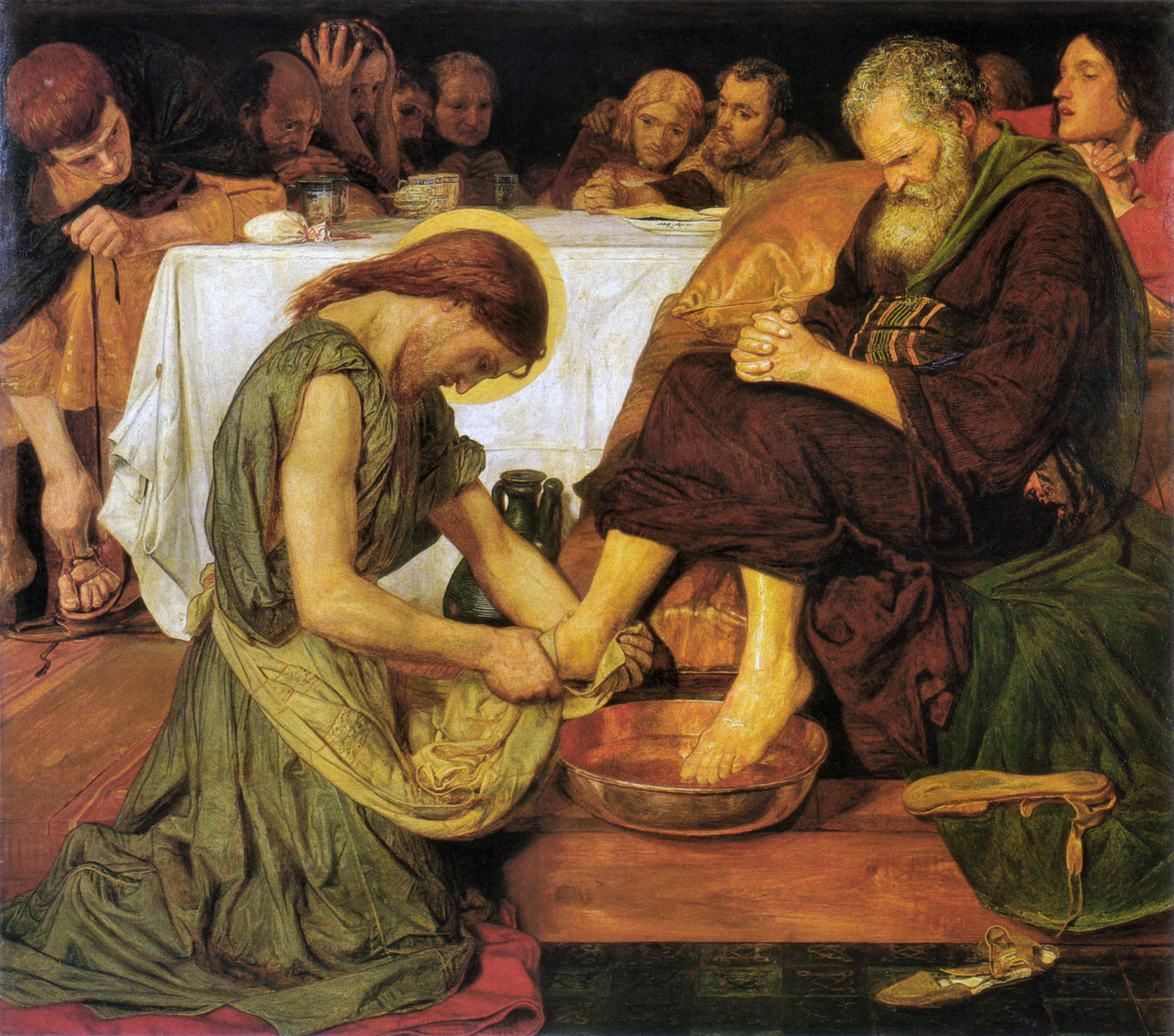
One of my favorite parts of the Gospel of John is chapter 13. It is the moment where Jesus washes the feet of the disciples at the Last Supper.  The humility of Jesus in this moment is tremendous.  But it wasn't until this past Holy Thursday that I was made aware of just how humble this act was.

My family has attended the Triduum for as long as I can remember: Mass on Holy Thursday, continued on Good Friday, and culminated on Easter Sunday morning, with Holy Saturday being a day, almost unconsciously, of spiritual silence and waiting.  (We also attend the traditional blessing of the Easter food on Holy Saturday, but that's a subject for a post down the road perhaps.) So this past Holy Thursday, I was back in my home parish once again, sitting with my family, a little tired from the ride back from my undergrad school, but beyond content to be home.  Our parish priest began his homily, and he spoke of something relevant to the Gospel (the Washing of the Feet) that I had never heard before.

The scene of this chapter in the Gospel of John is thus: Jesus and the Twelve have gathered for the Passover meal in the upper room.  Before they would partake of the meal, everyone's feet were to be washed.  All would have participated in the cleansing rituals for the celebration of the Feast already, so the only thing that was in need of washing was their feet.  The washing of the feet was one of those "most undesirable jobs" of Jesus' day.  The people of that time and place walked everywhere either wearing sandals or barefoot.  So, needless to say, their feet would have been filthy.  They also didn't have street-cleaners back then, so...you can imagine. Now the apostles are there with Jesus, waiting to partake of the Passover meal. But why are they waiting?

They are waiting to see who will be the one to stoop down and wash everyone's feet.  This was seen as the lowest job that the one who saw himself as the least in the group would take up as a service to the rest.  Who will be the one to make that act of humility and stoop to wash the feet of the others?

Jesus.

Jesus, knowing that the Father had given all things into his hands, and that he had come from God and was going to God, rose from supper, laid aside his garments, and girded himself with a towel.  Then he poured water into a basin and began to wash the disciples' feet, and to wipe them with the towel with which he was girded.  
~John 13:4-5~ 

Now at this point, I'm sure all of the apostles gathered were in shock and probably humbled themselves. Here is Jesus, their leader, their Lord, making the first move to take the job no one else wants to do and doing it with the heart of a loving servant.  Wow.... This is a very humbling moment for me as I read the Gospel with new eyes. How must it have been for the Twelve?  I can only imagine.

He came to Simon Peter; and Peter said to him, "Lord, do you wash my feet?" Jesus answered him, "What I am doing you do not know now, but afterward you will understand."  Peter said to him, "You shall never wash my feet."  Jesus answered him, "If I do not wash you, you have no part in me."  Simon Peter said to him, "Lord, not my feet only, but also my hands and my head!"  Jesus said to him, "He who has bathed does not need to wash, except for his feet, but he is clean all over; and you are clean, but not all of you."  For he knew who was to betray him; that was why he said, "You are not all clean." 
~John 13:6-11~


I love this particular image of this moment. Now, I'm not the biggest fan of Peter being portrayed as an old man, but then again, I don't know that he wasn't, so.... It's the emotion in the picture that I think strikes me the most.  Peter's obvious discomfort and disgruntled expression. Jesus' bowed head and loving, humble countenance. The apostles in the background, looking shocked, humbled, mystified, and moved by the scene before him.  The one on the end hurries to undo his sandals, perhaps wanting to save Jesus that task, or wanting to dive right into the mystery unfolding before him.

Consider also, this is all taking place before Judas leaves.  Jesus washes the feet of his apostles, even the one who will hand Him over to His rigged trial and undeserved execution.  This is another moment that forces me to come to grips with my own interior disposition.  Would I do that?  Would I be able to love like Jesus in that moment?  In moments of struggle in my own life?


When he had washed their feet, and taken his garments, and resumed his place, he said to them, "Do you know what I have done to you? You call me Teacher and Lord; and you are right, for so I am.  If I then, your Lord and Teacher, have washed your feet, you also ought to wash one another's feet.  For I have given you an example, that you also should do as I have done to you."  
~John 13:12-15~ 

These are a few of the parting words Jesus speaks to his apostles.  Everything is about to change.  Jesus knows it.  The apostles are more or less aware that something is about to happen, but Jesus' words continue to mystify them and they struggle to discern what He means when He says He is going away and so they must do this for one another. 

What we know follows this exchange is found in the other Gospels.  It is not recounted in John's Gospel because John wrote his much later than Matthew, Mark, and Luke, and so those who knew the Gospels had already heard the account of the Last Supper.  What John did was to fill in the blanks and recount the stories that had not been told yet.  Matthew, Mark, and Luke recount to us the institution of the Holy Eucharist at the Last Supper.  But also, with the words "Do this in remembrance of Me," spoken to the Twelve alone, gathered with Jesus at that particular moment for a particular reason,  He establishes the priesthood.  These men receive the gift from Jesus to do His work: to administer the sacraments (especially the Eucharist and Penance), to preach and to teach (signified by the commission of the apostles and the moment when Jesus gives to Peter the keys to the kingdom of heaven), and to wash the feet of every member of the Church in whatever situation they may find themselves.  They are to be the least in the kingdom, putting themselves at the service of the whole Church.  And I will take this moment to borrow an illustration from my Scripture professor, Dr. John Bergsma: 

People can often mistakenly think that the Pope is at the top of the "chain of command," that the bishops and priests are his "minions," if you will, and that the rest of the Church (laity, religious) rank the lowest and serve the priests, bishops, and Holy Father.  But this comes from a very secular view of leadership; not from Christ's example of leadership, which the Church strives to follow.   

The example that Christ shows throughout His life, but especially at the moment of the Last Supper, He Who would lead must be the servant of all. He even says in the Gospel of Luke: 

For which is the greater, one who sits at table, or one who serves? Is it not the one who sits at table? But I am among you as one who serves.
~Luke 22:27~ 

Jesus is greater than all of the apostles. Yet where is He? Stooped low, washing their feet. So what does leadership look like?  Flip that drawing up above upside down. 

The Holy Father is at the service of the Bride of Christ to care for her, protect her, and keep her in the truth.  He cannot do this astronomical task alone so God has given him the help of the bishops and priests.  So the Holy Father also serves those who help him, who then, in turn, serve all of the faithful.  

It is not uncommon these days to run into the question about why didn't Jesus ordain women.  Now, only Jesus Himself can tell us the answer to that question.  However, we must not forget that it is this same Jesus Who directs the decisions of His Church through the Holy Spirit.  The constant Tradition of the Church (not "tradition" as in rituals and practices that the Church preserves for piety; but Tradition, which is that which has been revealed by God, while perhaps not directly stated in Scripture).  St. John the Evangelist, and other New Testament writers, accounts for this by saying "There are many other things that Jesus said and did which are not written in this book; but these are written that you might believe."  So how do we know we can trust the Tradition of the Church?  The confidence we have in the Tradition of the Church is not only in the Holy Spirit, but in the witness of the apostles and the martyrs who were willing to (and did) die for the preservation of what had been revealed to them by Jesus and that they knew to be true.  In Paul's letter to Timothy, he exhorts him desperately to guard the deposit entrusted to him.  Why?  Because there are many who wish to twist it to suit their own preferences and motives.  To trust the Church is to trust the Holy Spirit; to trust the Holy Spirit, is to trust the One Who has sent the Holy Spirit: Jesus. To trust Jesus, is to trust the one Who sent Jesus: the Father.  The Church is cherished by God because she has been established to bring as many as possible into His kingdom for all eternity.  So God protects her with the inspiration of the Holy Spirit and a Teaching Office, the Magisterium, established to guard the deposit. 

It is also important to note the difference between dogma, doctrine, and discipline at this point.  These are different levels of Church teaching.  A dogma is an official definition of a particular teaching in order to make it as clear as possible what the Church teaches about this particular topic.  A doctrine is no less binding than a dogma.  It just isn't officially and specifically defined by the Church because the need to define it like that has not arisen, or an official teaching on a particular doctrine or topic of doctrine may never have been made. 

In other words, both doctrines and dogmas are infallible teachings of the Church.  What qualifies as a doctrine?  Anything that the Church has taught definitively throughout the ages, and officially through a public teaching on the subject.  An infallible teaching is not always something that the Pope declares officially of his own accord. That is an ex cathedra statement.  It may be a teaching that proceeds from an ecumenical council, that is a gathering of all the bishops for the purpose of clarifying the teachings on a particular subject.

A discipline is different.  A discipline is a practice of the Church adopted for a particular time and place.  A known discipline is the celibacy of priests.  This was not the constant practice of the Church: most of the apostles were married when Jesus called them to follow him.  But eventually, the Church, being sensitive to the demanding lifestyle of priests and the challenges this could create for their families, decided that it would be wise to ask priests to live celibate lives, given completely to the service of Christ and His Church. The discipline was also adopted to better model the priesthood of Christ, who lived a life of poverty, chastity, and obedience.

But the Church is continually guided by the Holy Spirit in these matters to know what teachings are not able to be changed.  The Church cannot change that Jesus made the decision at the moment He ordained His followers to change bread and wine into His Body and Blood, and the moment He ordained them to forgive sins, there were only men present.  Jesus was intentional about everything that He did.  This was no accident, and it certainly was not because He was worried about what people would think if He had chosen to have women present at the Passover.  Did concern for public opinion ever drive what Jesus did? He did it for a reason.  I cannot say that I know clearly what that reason is; but, I trust in my Lord and the Church He has given us to guard His teachings and lead us to Him.  I also trust this: our Lord, the one High Priest, as He is called in the letter to the Hebrews, and the One from Whom the whole priesthood of the Catholic Church flows, came to earth as a man for a reason. Can I say what that reason is? No. But I know that I can trust my God to know what He is doing, even if I do not understand fully.

And if you are going to bring up Pope Francis' statement about investigating the possibility for women in the diaconate, please read this. It's also worth noting that just a few months ago the Holy Father, when asked about ordination of women, was very clear that the teaching of St. John Paul II in Ordinatio sacerdotalist on this matter was the final word, and St. John Paul II firmly upheld that because Christ did not choose women as apostles (as is apparent in that the women who followed Jesus are never called apostles, and as is apparent by the fact that they were not present at the Last Supper).

I would, finally, like to bring forth a reflection that I have had recently.  I've been wondering for months if I should even write this post because of the heat it may receive.  But I felt this reflection was helpful to me, so maybe it would be helpful to someone else.


The sinful woman who washes the feet of Jesus. It is a beautiful, beautiful moment in the Gospels.  

But let's take this, for a moment, and place it alongside the moment in John 13.  The apostles are all sitting there waiting for the first person to make the move to humble himself and wash everyone's feet.  

What does the woman do?  She rushes into the room, falls at the feet of Jesus, and washes His feet with her tears and dries them with her hair.  She must have been aching to do this.  And through it she shows her great love for the Lord and repentance for her sins.  

It is not always the case, perhaps, but more often than not in my own experience, women are quick to respond to the needs of others and to serve those needs, even at personal cost.  Think of all the mothers you know who do this for their children everyday.  Now I am certainly not saying that fathers do not serve their families and make sacrifices everyday. I know that my own father does this alongside my mother every day of my life.  But there is almost a greater challenge for men, who are usually comfortable enough in the leadership position, to stoop down in humility like the sinful woman in the Gospel does.  For me, at least, there is a certain romance and attractiveness to that selflessness and a beauty to the way that she does not care what others think but simply wants to show Jesus that she is sorry and that she loves Him.  I'm not a man, so I can't speak for them as a whole, but...maybe that's harder. The images in the Gospels would make it seem so.  

Where am I going with all of this?  

I would simply like to offer the perspective that perhaps in the controversial issue of the ordination of women, we are missing the point.  First of all, the priesthood is not about authority so much as it is about service.  Secondly, what is the greater sacrifice for women? For men?  Perhaps the greater sacrifice for the woman is the humility to accept that the Holy Spirit has not led the Church to the ordination of women and so she must find other ways to serve the Church (and there are many other ways).  Perhaps the greater sacrifice for the man is the humility to put himself at the service of the whole Church, should God be calling him to it, in a vocation that can be spiritually rewarding, but also incredibly difficult and, at times, a thankless ministry.  

Before signing off, I would like to ask that the comments box not become a place for heated argument and ridicule.  There is no context, facial expressions, or body language offered in a comments box, so if you would like to talk to people about this in a way that treats them like people and where you can pick up on (better, anyways) what you should and should not say, please talk to people about this in person and not through a screen.  Finally, as a disclaimer, I would like to say that my sole purpose in writing this post has been to share with you my thoughts on the subject in light of the teachings of the Church and the inspired Scriptures.  You have a free will, and if you do not like what I say, you are free to ignore it.  In the words of St. Peter: 
So I would ask that you please be mindful of your demeanor if you do respond to this post.  Before you answer, ask yourself: "Is this for God's glory, or my own?" Please remember the dignity of all those who may be reading this post.  

Until our next meeting, pace e bene, 
the Itinerant Catechist

Thursday, November 10, 2016

Elections, Friendships, and the Gospel

I promise this post is not meant to be political.

The election is over. In the aftermath, there has been a great deal of confusion, frustration, anger, hateful words, division, unfriending, rants, despair.... The list goes on.  It's a lot to take in. People are afraid.  And when people are afraid, they say things they would not say otherwise. People are angry, and they will also say things they would not say otherwise because they are angry.

But the people who are explosive and angry have not caught my attention. I'm more drawn to those who are not swayed by the outcome of an election.  What I mean by that, I have a deep admiration for those who don't let things like this shake their faith (or their friendships).  Those people who continue to believe and trust that God is still in total control.

I would like to share something with you all. On election day, I read chapter 12 of the Gospel of Matthew. It was not premeditated.  I didn't choose this chapter for this particular day. But as I've been working my way through the Gospel of Matthew, I opened my Bible on election day to that chapter.  And I don't think that was any coincidence.  This is what I read there:

Matthew 12:25 and following "Knowing their thoughts, He said to them, 'Every kingdom divided against itself is laid waste, and no city or house divided against itself will stand.... But if it is by the Spirit of God that I cast out demons, then the kingdom of God has come upon you.'"

And, yesterday, as I became more and more aware of how much hate and anger was going around on social media, my thoughts returned to this passage.  The worst thing about this election season, as I see it, is the enormous division that has arisen among Americans.  It didn't matter who you were voting for.  If you weren't voting for the same person as another person was voting for, you were "unpatriotic," "bigoted," "racist," "criminal," and all other sorts of things that I will not repeat on principle.  Look around you! What is this that is happening in America?  This once great nation is being laid waste by disunity and hatred.  If we want to see our country rise out of these dark times, then it's going to require something of us.  We're going to have to overcome our differences and unite.  We're going to have to work together.  We're going to have to acknowledge and accept one another's shortcomings and choose to love one another because we are all human beings.  I know a lot of people are scared. A lot of people are angry. A lot of people just don't know what's going to happen. But, the truth of the matter is, the division that has been created this election season is doing a lot more hurt than good.

It has also been shocking and saddening to me that people have been losing friendships over this election.  No wonder we are suffering from so much disunity.  If we can't even consider someone whose opinion differs from ours a friend, then how far have we fallen?  Again, I find it no coincidence that this week I was also reading the chapter on Friendship in C.S. Lewis' The Four Loves. C.S. Lewis says of friendship that it is "...the least natural of loves," by which he means friendship is not necessary for survival.  He says: "...we can live and breed without Friendship.  The species, biologically considered, has no need of it."  

He goes on to say: 
"This (so to call it) 'non-natural' quality in Friendship goes far to explain why it was exalted in ancient and medieval times and has come to be made light of in our own.  The deepest and most permanent thought of those ages was ascetic and world-renouncing.... But in Friendship - in that luminous, tranquil, rational world of relationships freely chosen - you got away from all that.  This alone, of all the loves, seemed to raise you to the level of gods or angels."  

Friendship isn't (or shouldn't be) about agreeing with someone on everything.  Look at Lewis himself.  He and J.R.R. Tolkien were very dear friends.  But the number of things they disagreed on was equal to (if not greater than) the number of things they agreed on.  This didn't end their friendship.  

Personally, I think these two would have been appalled by the "Facebook friends" trend, where you can call someone your "friend" without them being your "friend" in the truest sense of the word.  C.S. Lewis believes friends are friends because they share a common interest.  They rarely talk about their friendship (as opposed to those in romantic relationships, Lewis says, who seem to only talk about one another).  Some of the greatest friendships (ask someone who has been friends with a particular person for more than 20 years) are those friendships where we are challenged by our friends to be better.  In college alone I saw a number of friendships struggle, to their end or to their redemption.  But when the struggle passes, if the friendship still stands, it stands the stronger.  But it would not have been that way had the people involved simply given up on it.  They were willing to sacrifice, willing to try, willing to fail.  But they gave it a chance.  

I don't mean to condemn those friendships that struggled and failed.  Sometimes, this too, is necessary, though it be painful.  Blessed Fulton J. Sheen once said: “Sometimes the only way the good Lord can get into some hearts is to break them.” 

This only makes sense if we understand love as willing the good of the other.  And, as John Paul II categorized friendship as the highest form of love, the great saint defines friendship as "willing the good of the other for the other's own sake." That is to say, "That person is my friend, and I desire what is best for that person. I not only desire it, but I will it.  And I will it with no expectation or desire of reward."  

One of my favorite contemporary Catholic speakers is Chris Stefanick of Real Life Catholic.  The day after the election, he posted a video in which he said: 

"Respect each other. There is no political party, no election is worth losing friendships over. There is no political party, no president that is worth getting into debates that might close the door for you to bring the Gospel of Jesus Christ to your friends and family for." 

What's a true testimony of true friendship?  That I unfriend you because of your political beliefs? Or that I allow you to express your political opinions, even though I may disagree with them, and that your expression of what you think does not change the fact that I consider you a friend? 

To continue His beautiful and amazing way of rocking my world and blowing my mind (even just a little), I opened up my Bible yesterday to keep reading through Matthew's Gospel, and once again the contents seemed super appropriate for the aftermath of this election. 

Jesus has just dealt with a lot of verbal opposition from the Pharisees.  Earlier, they had accused His disciples of breaking the Sabbath. Now they've accused Him of casting out demons by the power of Satan, and then they demanded a sign of Him... basically, Jesus has had a hard day, and probably an exhausting one.  Because, remember, He's fully man as well as fully God, He can get exhausted.  

So, chapter 13 of St. Matthew's Gospel, it says: 

That same day Jesus went out of the house and sat beside the sea.  And great crowds gathered about Him, so that He got into a boat and sat there; and the whole crowd stood on the beach. 

Now, if I was in Jesus' place, I think I would be exhausted.  I would've wanted my quiet time by the beach and just asked everyone to come back another day. But Jesus doesn't do that.  He continues to carry out the mission that He has received from the Father.  
The Sower by Millet

 And He told them many things in parables, saying: 'A sower went out to sow. And as he sowed, some seeds fell along the path, and the birds came and devoured them. Other seeds fell on rocky ground, where they had not much soil, and immediately they sprang up, since they had no depth of soil, but when the sun rose they were scorched; and since they had no root they withered away. Other seeds fell upon thorns, and the thorns grew up and choked them. Other seeds fell on good soil and brought forth grain, some a hundredfold, some sixty, some thirty. He who has ears, let him hear."

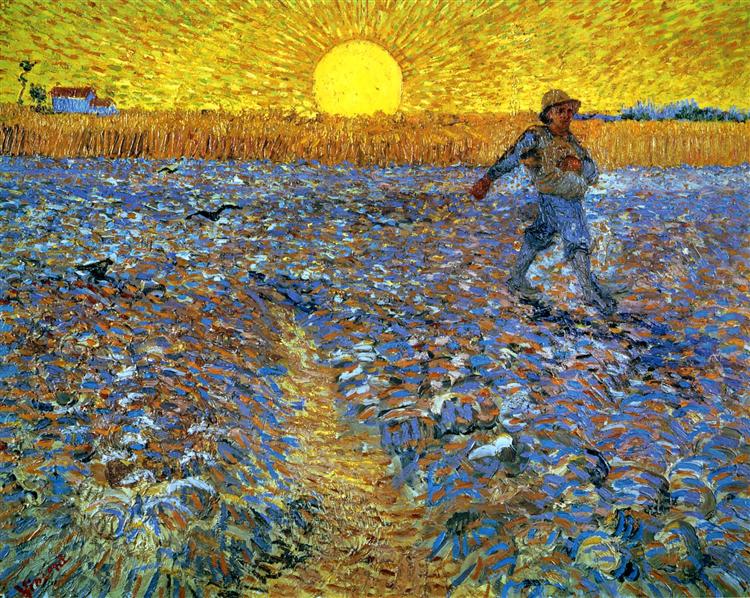
The parable is also relevant for us in this moment in history.  The sower went out to sow.  The sower doesn't know what seeds will sprout and what seeds won't.  He sows them anyway.  He doesn't know how much fruit the seeds will bear or how much of a harvest he will have. He sows them anyway.  There is an uncertainty that comes with his role.  That uncertainty of the future doesn't stop him from doing the task he has been given to do.  And it shouldn't stop us either, particularly those of us who are engaged in the work of evangelization and catechesis.  No matter what is going on in the world or in our own little world of our personal lives, we have been given the task of proclaiming the Word of God, whether it is convenient or inconvenient.  The election doesn't change that.  (In fact, I think it makes it all the more important!)  
The Sower by Van Gogh
But, not only do we need to embrace the role of the sower, we need to recognize the truth that we are the soil.  To what measure is the soil of my soul prepared to receive the Gospel and for that Gospel to bear fruit in my life?  Which kind of soil am I? Am I the trodden path?  The rocky soil?  The thorny patch? Or the good soil?  What things do I need to weed out of my life for the Gospel to take root and not be choked by my worldly concerns?  What parts of my heart have become to hardened to receive the Word? and how can I break up that soil?  What places in my life need more good soil added to them so that there is a good foundation for the Gospel to take root? 
How can I work with Jesus the Sower to make my heart a patch of good soil that is ready to receive the Gospel?  This is what will make a difference in the world; even more of a difference than who is in the White House.  

As J.R.R. Tolkien said, "Even the smallest person can change the course of the future."  

And, to quote a movie less renowned than the great 20th century author, "How do we change the world? One act of random kindness at a time." (Evan Almighty, 2007)

We need to acknowledge that the only One Who can heal the wounds of this nation, is the One that so many are trying to push out of government matters altogether: Jesus Christ.  He is the answer.  If only more people would believe this!  We need to stop placing so much faith in an elected official and a government to lead us and take care of us, and start putting all our faith in Jesus Christ. We are citizens of His kingdom first. And guess what: He still reigns since 33 A.D. (and long before). He is our one and only Hope. Now and forever. 

Until we meet again, I leave you with this parting thought: 

Pace e bene,
the Itinerant Catechist